
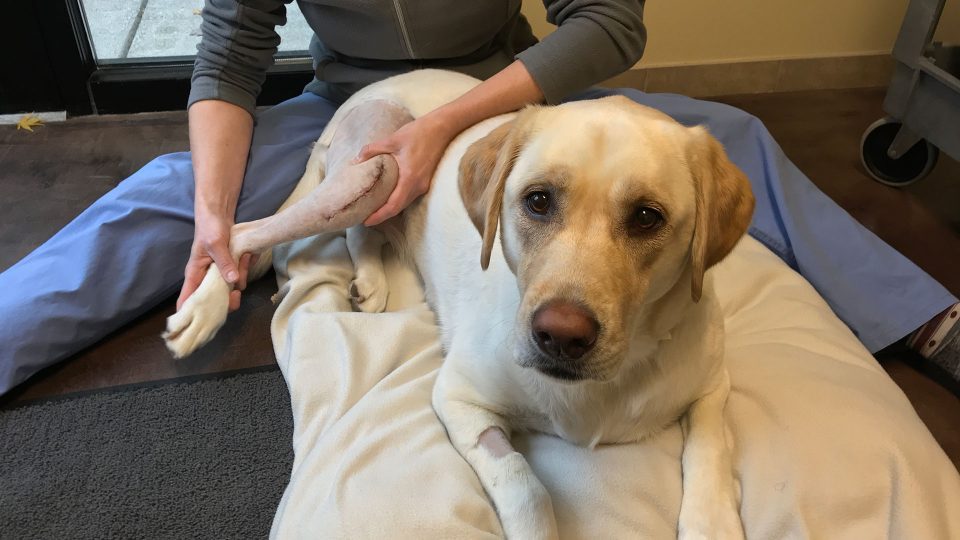
The diagnosis of OA starts with an index of suspicion. When you meet Lucy, a 10-year-old Labrador that is weak in the pelvic limbs and the client describes her as “slowing down,” you will probably suspect that Lucy has OA affecting at least one joint of her pelvic limbs.
When this client presents to you with the complaint of Lucy’s lameness or “slowing down”, you will likely pursue a workup looking for orthopedic disease and OA.
But what if Lucy’s appointment with you was actually for the complaint of an ear infection, and in the course of the conversation, the client notes that her dog is “slowing down.” Will you have time in the consultation to perform an orthopedic exam and discuss treatment options? Will your client be receptive to discussing something that she did not perceive as a problem?
The answers to these questions may often be ‘no,’ in which case, your patient may go on suffering from OA without an established diagnosis and treatment plan. This is a challenge that all veterinarians face (specialists included), but one that we need to overcome in order to be the best advocates for our patients as possible.
There are three methods that we suggest to begin the conversation around and diagnosis of OA in dogs:
- Start early! As described in our article on OA pathophysiology, OA is a secondary disease in dogs, meaning that something leads to the development of arthritis such as hip dysplasia or CCL disease. Developmental orthopedic diseases can be identified during the first year of a dog’s life. Follow the OA Screening Tool (also listed in Forms box at right) to help identify patients at risk of OA.
- Plant the seed and schedule a follow-up. Use the ORTHO SCREENING EXAM (video linked in box at right) during any appointment to identify potential indicators of OA, then let the client know that you have found something that concerns you, and you would like to schedule a follow-up exam (Hint: do not try to sell the client something for OA yet, they may grow suspicious). Once you have time to do a thorough Orthopedic Exam Form, you will also have time to discuss your concerns and treatment recommendations.
- Direct your clients to caninearthritis.org. If your client is resistant to scheduling a follow-up exam with you, suggest that they visit our website. Here your client will learn the basics of OA and take a short quiz that can help identify DOD, OA, and pain. Then they will be directed back to you for a thorough examination, diagnosis and treatment plan. You can even provide your client with a free trial week CARE subscription!
When it comes time to schedule your patient for an OA Consultation, be sure to schedule a longer appointment than normal (we suggest at least 45 minutes). This will allow you time to have a detailed discussion with your client and perform an orthopedic examination (COMPREHENSIVE ORTHO EXAM). Based on this exam, you will be able to assign an OA stage to your patient and/or recommend further diagnostic tests. You will also be able to make treatment recommendations appropriate for the individual patient. (SEE COMPREHENSIVE PLAN)
Don’t forget, just as important as diagnosing OA and developing a treatment plan is following up with your patient and client to ensure that your plan is working and make adjustments as needed. You should recheck your patient 2-4 weeks after starting an OA plan, and again with 3 and 6 months. We recommend even more frequent rechecks when weight loss is part of the plan. (SEE Long Term Management)
EARLY IDENTIFICATION OF OA
Below is a list of known factors that lead to, or increase the risk of, developing OA in dogs. If your patient meets any of these criteria, you should SCREEN them for OA. You can also assign an OA stage that will help you monitor your patient over their lifetime.
Known risk factors for developing arthritis:
- Developmental orthopedic disease (DOD) such as hip or elbow dysplasia, MPL, OCD
- Breed (DOD are hereditary, and certain breeds such as Labrador Retriever, Golden Retriever, German Shepherd, Rottweiler, French Bulldog, Newfoundland, and Bernese Mountain Dogs have a higher incidence of DOD. This is not an exhaustive list; any breed of dog, including mix breeds, can develop DOD, but certain breeds should be screened more closely).
- Being overweight or obese
- History of joint trauma or joint surgery
- Spayed or neutered, especially prior to skeletal maturity (Learn more here)
- Engaging in high impact, repetitive activity (dogs that have normal joints, but sustain repetitive abnormal forces to the joints, such as jumping down, twisting, or spinning may be at increased risk of ligament sprains that could lead to joint instability and OA).
- History of joint infection or systemic infection such as tick-borne disease
- Autoimmune disease
Stages of OA
Staging allows you to identify dogs at risk of developing OA and those with clinical symptoms of OA. Then, you can track your patient’s response to treatment and the progression of OA over the dog’s lifetime.
Identify the stage using the following chart.
5 Stages of OA
| Stage | Signs | Examples |
|---|---|---|
| 0 | No risk factors, no clinical signs | 5-year old Standard Poodle without any lameness or DOD. If this dog were to sustain trauma/fracture to a joint, he would be at risk of developing OA |
| 1 | At risk, no current clinical signs | 4-month old Labrador with positive Ortolani sign. Six-year-old Boxer that is overweight |
| 2 | Mild clinical signs | 1-year-old Golden Retriever that occasionally has thoracic limb lameness after playing |
| 3 | Moderate clinical signs | 8-month old Rottweiler that is always lame on left thoracic limb. 9-year-old Pit Bull mix with bilateral CCL tears; one side was treated surgically, the other has not been treated surgically. |
| 4 | Severe clinical signs | 10-year-old Lab mix that cannot climb the stairs, jump in the car, and does not want to go for walks. |
You can also use the OA Screening Tool, listed below and linked in the box at the right.
OA SCREENING TOOL
| Breed at risk (See list of top 20 breeds) any age; start screening and discussion at time of puppy exam | ||
| Overweight/ obese BCS >6/9 | ||
| Known DOD (HD, ED, OCD, MPL) | ||
| CCL Disease (any degree of CCL tear) | ||
| History of joint trauma or surgery | ||
| Age >8 years | ||
| Canine athlete or working dog |
If any of the above answer YES, this dog is at least STAGE 1 OA and should be further screened using our OA SCREENING EXAM.
OA SCREENING EXAM
The purpose of the OA screening exam is to incorporate basic orthopedic exam techniques that may indicate orthopedic disease/ OA into your general physical exam. The OA SCREEN should take no more than 1-2 minutes to complete. Results of this screen are not expected to diagnose a specific orthopedic condition but rather suggest that further orthopedic examination is indicated.
| Gait: observe the dog walking around the exam room prior to physical exam | Obvious lameness Unwillingness to walk | ||
| Posture: observe the dog standing on the floor of the exam room prior to physical exam | Weight shifting off one limb Kyphosis Lordosis Caudal pelvic tilt Asymmetric position of paws and digits | ||
| Transitions: observe the dog moving from stand to down, down to stand, stand to sit and sit to stand | Slow or unable to rise from ‘down’ unassisted Positive sit test Asymmetric use of limbs to stand | ||
| Muscle atrophy: with the dog standing, palpate for muscle symmetry in thoracic and pelvic limbs | Asymmetric muscle mass | ||
| Joint swelling/ effusion: With the dog standing, palpate elbows, carpi, stifles and tarsi for swelling | Asymmetric palpation of joints Firm swelling, typically on medial aspect of stifle or tarsus Thickening of the Achilles tendon insertion | ||
| Paraspinal palpation: With the dog standing, palpate along the paraspinal muscles in the thoracolumbar region | Muscle spasm/ tenderness | ||
| 3 leg stand: Lift each limb up individually and asses willingness to stand on the contralateral limb | Asymmetry between willingness to allow limbs to be lifted/ weight bearing on contralateral limb Compensation or collapse through limb that the dog is standing on |
COMPREHENSIVE ORTHOPEDIC EXAM
The Comprehensive Orthopedic Exam includes obtaining a detailed history from the client, observing the patient’s mobility prior to palpation, standing palpation, and recumbent palpation. It is very important to schedule yourself enough time to perform the examination without rushing and making the dog more nervous.
Sometimes it will not be possible to complete the comprehensive orthopedic exam in the scheduled visit due to the dog’s temperament. In these cases, you may need to use anti-anxiety and/or sedation to facilitate a stress-free examination. When this is needed, having the client drop the dog off for a few hours may help the patient acclimate to the environment and allow you to perform a thorough exam.
Click here for additional details for completing the Comprehensive Orthopedic Exam and here for the accompanying Orthopedic Exam Form.
Clinical Metrology Instruments
Clinical metrology instruments, or CMIs, are questionnaires that a client completes specific for their pet’s level of pain and functional activity. Examples of CMIs include the Canine Brief Pain Inventory (CBPI), Canine Orthopedic Index (COI), and Liverpool Osteoarthritis in Dogs (LOAD).
These questionnaires have been validated, meaning that they have stood up to rigorous testing to show that they are able to detect pain or disability in dogs. More importantly, these tests have also been shown to be responsive, meaning that they can detect response to treatment in dogs with OA. Client Specific Outcome Measures (CSOM) is a type of CMI that allows clients to identify (typically 3) functional limitations specific to their dog and assign a score.
The first time a client fills out a CMI, it may help you detect OA and educate the client by showing them that they have identified symptoms of chronic pain in their dog. In this way, CMIs can serve as a screening tool for OA and chronic pain.
The true value of a CMI, however, lies in the ability to monitor response to treatment. Clients should complete additional CMIs at follow up examinations in order to help you determine changes that need to be made to the plan.
NEXT STEPS: Diagnosis vs. Diagnostics
After completing a comprehensive orthopedic examination, you will hopefully narrow the source of lameness and pain to the limb(s) and joint(s) of concern. You may even have established a definitive diagnosis (such as MPL or CCL rupture). You will note your problem list and differential diagnoses, then make recommendations for additional diagnostics and/or treatment based on your findings.
Typically the next step in working up a dog with orthopedic disease is to obtain high-quality radiographs. You may elect to perform these radiographs in your hospital, in which case sedation and analgesia are recommended in order to minimize stress and obtain the highest quality and most useful films (ex: 4 mg/kg trazodone + 10 mg/kg gabapentin PO +/- additional injectable anxiolytics/ sedatives).
You may also consider referring your patient to an orthopedic specialist (surgeon or rehabilitation/ sports medicine diplomate) for further diagnostics such as CT, MRI or arthroscopy. Ideally, you would continue to work with the specialists and client to develop a long term, customized plan for managing your patient’s diagnosis and associated OA.
References
Brown, D.C., Boston, R.C., Coyne, J.C., Farrar, J.T., 2008. Ability of the canine brief pain inventory to detect response to treatment in dogs with osteoarthritis. Journal of the American Veterinary Medical Association 233, 1278–1283.
Cachon T, Frykman O, Innes JF, et al. Face validity of a proposed tool for staging osteoarthritis: Canine OsteoArthritis Staging Tool (COAST). Vet J 2018.
Fox, SM. Multimodal management of canine osteoarthritis, 2nd Ed. CRC Press. 2017
Hart BL, Hart LA, Thigpen AP, et al. Long-term health effects of neutering dogs: comparison of Labrador Retrievers with Golden Retrievers. Plos One 2014.
Hercock, C.A., Pinchbeck, G., Giejda, A., Clegg, P.D., Innes, J., 2009. Validation of a client-based clinical metrology instrument for the evaluation of canine elbow arthritis. Journal of Small Animal Practice 50, 266–271.
Loeser, R.F., 2010. Age-related changes in the musculoskeletal system and the development of osteoarthritis. Clinics in Geriatric Medicine 26, 371–386.
Mele, E., 2007. Epidemiology of osteoarthritis. Veterinary Focus 17, 4–10.
Walton, M.B., Cowderoy, E., Lascelles, B.D.X., Innes, J.F., 2013. Evaluation of construct and criterion validity for the ‘Liverpool Osteoarthritis in Dogs’ (LOAD) clinical metrology instrument and comparison to two other instruments. PLoS One 8, 2013.
WSAVA Global Pain Council, 2014. Guidelines for recognition, assessment and treatment of pain. Journal of Small Animal Practice 55, E10–E68.
Brown, D.C., Boston, R.C., Coyne, J.C., Farrar, J.T., 2008. Ability of the canine brief pain inventory to detect response to treatment in dogs with osteoarthritis. Journal of the American Veterinary Medical Association 233, 1278–1283.
Cachon T, Frykman O, Innes JF, et al. Face validity of a proposed tool for staging osteoarthritis: Canine OsteoArthritis Staging Tool (COAST). Vet J 2018.
Fox, SM. Multimodal management of canine osteoarthritis, 2nd Ed. CRC Press. 2017
Hart BL, Hart LA, Thigpen AP, et al. Long-term health effects of neutering dogs: comparison of Labrador Retrievers with Golden Retrievers. Plos One 2014.
Hercock, C.A., Pinchbeck, G., Giejda, A., Clegg, P.D., Innes, J., 2009. Validation of a client-based clinical metrology instrument for the evaluation of canine elbow arthritis. Journal of Small Animal Practice 50, 266–271.
Loeser, R.F., 2010. Age-related changes in the musculoskeletal system and the development of osteoarthritis. Clinics in Geriatric Medicine 26, 371–386.
Mele, E., 2007. Epidemiology of osteoarthritis. Veterinary Focus 17, 4–10.
Walton, M.B., Cowderoy, E., Lascelles, B.D.X., Innes, J.F., 2013. Evaluation of construct and criterion validity for the ‘Liverpool Osteoarthritis in Dogs’ (LOAD) clinical metrology instrument and comparison to two other instruments. PLoS One 8, 2013.
WSAVA Global Pain Council, 2014. Guidelines for recognition, assessment and treatment of pain. Journal of Small Animal Practice 55, E10–E68.