
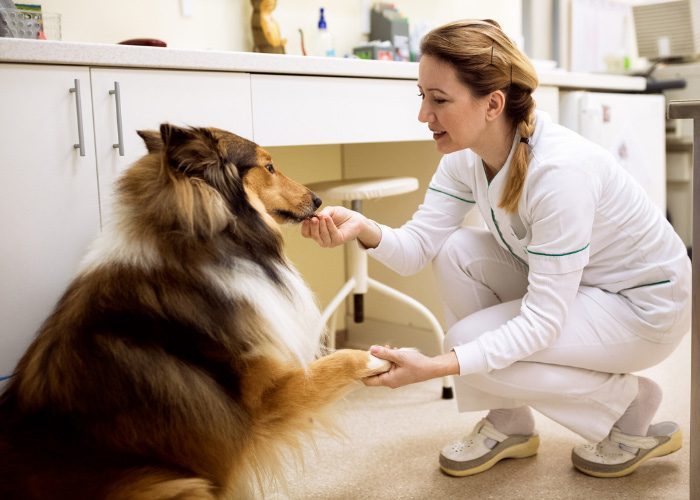
The CARE Orthopedic Exam Form is designed to help you systematically perform a thorough orthopedic examination. You can customize this form to accommodate your particular examination techniques.
If your hospital is paperless or paper-lite; you could use this form and then scan it into the patient’s record. Alternatively, some medical record systems allow you to customize your exam templates and you could follow this outline to create your own electronic form. A well-documented exam will help you with your follow up appointments and when collaborating with specialists.
When performing the Orthopedic Exam, remember the following points that will help you be successful:
- Schedule enough time for the exam; this may mean asking the client to drop the dog off for an “orthopedic workup.”
- Use stress-reducing techniques to allow the dog to relax; it is no longer acceptable to “muscle” through an orthopedic exam trying to get a dog to vocalize. The dog should be as comfortable as possible and you should be observing for subtle signs of discomfort or abnormality.
- Pharmaceuticals can be very valuable in aiding with the exam. Oral trazodone with gabapentin, administered 1-2 hours prior to the exam (as long as there are no contraindications) is often enough to allow you to complete the exam with the patient compliant but alert and still able to demonstrate areas of discomfort.
- Some dogs will require heavier sedation and/or a muzzle. Never risk your or your staff’s safety.
- There are continuing education courses offered that can help improve your anatomy and palpation skills. The Canine Rehabilitation Institute: Introduction to Canine Rehabilitation course is highly recommended for this purpose, even if you do not plan to offer full-scale rehabilitation therapy.
Using the CARE Orthopedic Exam Form
Part 1: Patient History and Client Goals Summary
The top portion of the first page will be completed prior to the examination; these details will be based on your client information and Orthopedic History Form.
- The entire form is to be filled out by you/your technician. You may also want to include signalment if it helps you remember the details of the patient.
- Feel free to use short-hand when completing the form, so long as it’s generally medically acceptable for complete record keeping.
- CMI Completed: Check the box if you have asked the client to fill out one of these questionnaires. If you only use one form in your practice, delete the others as options (or add a CMI, such as LOAD, if it is not listed).
- Presenting complaint: From the Orthopedic History form—the summary of why you are performing an Orthopedic Exam.
- For example: 3 wk history LH lameness, or, slowing down in the past year.
- Owner’s goals: Don’t forget how important this question is—does the client “just” want their dog to be comfortable (Yay! This is a great answer!) or do they want to go for 7-mile hikes or play Flyball? This will help you develop a realistic plan and set realistic expectations.
- Home video findings: How often have you seen a patient and the client says, “well, they are acting fine now.” The old, when-you-take-your-car-to-the-shop issue. We are very lucky these days that almost everyone carries a video camera in their pocket. Ask the client to show you a video of the lameness or mobility concern in the home environment.
Part 2: Patient Data—Observation
- This section will collect information before you palpate the dog
- Body condition score should ALWAYS accompany body weight. You can customize this if you use a 1-5 scale. Click here for a BCS chart from the World Small Animal Veterinary Association (WSAVA).
- Gait analysis:
- If you have a numeric scale that you use for gait evaluation, that is OK, but remember that it is probably different than your colleague down the street, and different again from the surgeon around the corner.
- There are several scales used in small animal orthopedics, and none are exceptional at providing details of the gait beyond the degree of weight-bearing, and they do not take into account the entire body. If you use a numeric scoring system, it is recommended that you add your scale to this form so that the numbers and descriptors are clearly listed under “Gait Analysis.”
- Here is the lameness scale we use most often:
Lameness Scale
This is the scale CARE recommends for monitoring lameness| Grade | Lameness at a walk or trot |
|---|---|
| 0 | No lameness observed |
| 1 | Slight lameness |
| 2 | Obvious weight-bearing lameness |
| 3 | Severe weight-bearing lameness |
| 4 | Intermittent non weight-bearing lameness |
| 5 | Continuous non weight-bearing lameness |
-
- Descriptive language can also be used for gait analysis, such as “severe weight-bearing lameness of the LH with decreased swing phase and mild circumduction.” Or “Intermittent NWB R and L, normal gait pattern in between.” Or “ataxic gait x 4.”
- Gait analysis can be intimidating and takes time to master. But remember, just describe what you are seeing!
- The best way to identify abnormal gait is to get very comfortable with what normal looks like. Take every opportunity to you have to watch dogs walk and trot normally (at the park, dog show, etc). Sorry though, now you will not be able to see or meet a new dog without critiquing their gait!
- Slow-motion video can be very useful!
- Sometimes you will be able to identify lameness in the exam room or hallway; other times it will be beneficial to go outside for more space.
- The dog should be walked on a leash by the client or your assistant’s side, do not allow the dog to pull or sniff. They should walk, then trot, straight forward and away from you, several times. Then you should move to the side and watch from other angles.
- Thoracic limb lameness: look for “down on the sound” limb. Dogs will try and off-load the limb that is painful, resulting in increased weight-bearing through the normal, or less painful, thoracic limb. There will be a head bob associated with this. Look closely to see which side the head is going down—the opposite side limb is usually the “problem,” ie, down on sound.
- Pelvic limb lameness: look for “hip hike.” Dogs will off-load the limb that is painful, resulting in increased weight-bearing through the normal, or less affected, limb. Look for the side that the hip rises—this is the “problem” side because they are going down on the sound leg.
- Look for decreased swing phase—rather than the limbs extending in front and behind as normal (you have to know what normal looks like), the gait may appear short and choppy.
- Non-weight bearing on one limb will result in compensation in other limbs, describe, if possible, what you see in the weight-bearing limbs.
- Watch the dog move in both walk and trot gaits. Lameness often shows up in trot rather than walk. You may also pick up on changes/ lameness during the transition between gaits.
- Posture
- Observe the dog in the exam room when he does not think you are looking at him. Does he shift weight off of one limb? Hold a leg straighter than the other side? More flexed than the other side? Stand on the top of his foot (CP deficit)?
- Look for neck and spinal motion. Does the dog do “whole body shakes?” If so, it is unlikely that they have neck pain. Or, do they hold their neck in a neutral position and move their eyes or body to see?
- What is the shape of the spine or “top line.” Is there kyphosis (hunched back like the Halloween black cat) or lordosis (spine dips ventrally like “cow pose” in yoga). Does the pelvis tuck under more than it should due to increased hip and lumbar flexion?
- Remember, know what normal is, then describe anything you see that is abnormal.
- Transitions
- Observe how the dog sits when she is not specifically asked to. Does she shift off to one hip with the opposite pelvic limb held out to the side (positive sit test)? Or does she sit symmetrically (normal)? Does she sit at all or immediately lay down?
- When she stands from a “sit,” does she use both pelvic limbs to thrust or just use one? Does she struggle to stand up?
- Observe or ask the dog to lay down. Can they hold a symmetric “sphinx” position or immediately shift to one hip? Are they able to lay down easily or is a struggle for them and they “plop.”
- Ask or observe the dog to stand from the down position. Do they stand easily using both back limbs? Do they shift from a down, through the “sit” then stand? Are they unable to stand without assistance?
- Note any other observations you see- normal or abnormal.
Part 3: Patient Data—Palpation
You may complete the palpation exam in standing or lateral recumbency or both, depending on the dog’s comfort level. Ideally, leave the primary limb of concern until last so that you avoid “tunnel vision” and manipulate the painful area at the end of the exam.
- See the Comprehensive Ortho Exam for details on performing palpation or watch the accompanying video.
- Palpate for:
- Muscle symmetry/ atrophy
- Peri-articular thickening
- Joint effusion
- Joint range of motion
- Joint stability
- Bone pain
- Axillary masses or pain
- Achilles tendon thickening/ asymmetry
- Paraspinal muscle fasciculations/ spasms/ trigger points
- Spinal pain
- Muscle trigger points
- Flexor carpi ulnaris thickening
- Cranial drawer, cranial tibial thrust
- Patella luxation
- Biceps stretch test
- Evaluate the digits, pads, inter-digital space
- Record abnormalities in the appropriate section
Part 4: Neurological Screening
Sometimes it is hard to distinguish between orthopedic and neurologic causes of lameness and pain. A Neuro Screening should accompany the Orthopedic Exam, and if any abnormalities are noted, a full neurology exam is indicated. This may help guide when to refer to a neurologist vs. orthopedist.
- Proprioception: This tests proprioception along the path from the skin, joints, muscle/tendons, afferent nerves, spinal cord, brain, and efferent nerves. It is not a specific test for neurologic disease as disruption anywhere along the pathway can lead to an abnormal finding. However, it is a fundamental component of the neurologic exam.
- Support the dog under their body; if they are very weak they may have a hard time replacing the foot.
- Withdrawal is a spinal reflex that can easily be tested by gently pinching a toe and looking for the limb to flex.
- This test is very distinct from deep pain, in which you have to pinch the digit hard and look for a conscious response. Withdrawal is only looking for the limb to flex. Don’t cause pain! If the dog can walk, it can feel pain!
- The patellar reflex is tested with the stifle partially flexed. It is testing the femoral nerve and spinal cord segments. (L4-L6)
- When testing reflexes it is useful to compare one side to the other.
- As described under Posture, look for neck and spinal motion. Does the dog do “whole body shakes?” If so, it is unlikely that they have a neck pain such as cervical IVDD. Or, do they hold their neck in a neutral position and move their eyes or body to see?
- Note any observations from the previous exam that may suggest neurologic disease.
Optional: Joint Range of Motion
Objective measurement of passive joint range of motion using a goniometer can be useful to identify asymmetry and track response to treatment. Continuing education courses and references are available to learn to perform goniometry. Some rehabilitation therapists may document goniometric measurements for every joint. Many others will document only the abnormal joint(s) (as assessed manually) and the contralateral equivalent joint(s).
Part 5: General Physical Exam
This section includes components of a general physical exam (PE) that should be included with an Orthopedic Exam, presuming that the exam is taking place on a different day than a general exam appointment.
Not included is obtaining a rectal temperature. This is in order to allow the dog to relax such that you can perform the thorough orthopedic examination. However, if there is any concern for systemic illness and/or inflammatory or septic joint disease, the body temperature should be taken.
Part 6: Pain Score
Numeric pain scales ask you +/- the client to rate the patient’s pain on a scale, such as 1-10. These scales are not as good at detecting subtle pain as CMIs or questionnaires. Nevertheless, it is easy to incorporate a numeric pain scale into your evaluation and re-evaluation of patients. We use the scale: 0= no pain; 10 = extreme/ worst pain
Part 7: OA Stage
Staging allows you to identify dogs at risk of developing OA and those with clinical symptoms of OA. Then, you can track your patient’s response to treatment and the progression of OA over the dog’s lifetime.
5 stages of OA:
5 Stages of OA
| Stage | Signs | Examples |
|---|---|---|
| 0 | No risk factors, no clinical signs | 5-year old Standard Poodle without any lameness or DOD. If this dog were to sustain trauma/fracture to a joint, he would be at risk of developing OA |
| 1 | At risk, no current clinical signs | 4-month old Labrador with positive Ortolani sign. Six-year-old Boxer that is overweight |
| 2 | Mild clinical signs | 1-year-old Golden Retriever that occasionally has thoracic limb lameness after playing |
| 3 | Moderate clinical signs | 8-month old Rottweiler that is always lame on left thoracic limb. 9-year-old Pit Bull mix with bilateral CCL tears; one side was treated surgically, the other has not been treated surgically. |
| 4 | Severe clinical signs | 10-year-old Lab mix that cannot climb the stairs, jump in the car, and does not want to go for walks. |
Part 8: Assessment
Briefly list your differential diagnosis and/ or working diagnosis and assessment based on the examination.
Part 9: Goals
Describe your goals, as they relate to the Assessment and Client Goals. Ideally, SMART goals should be set. This means Specific, Measurable, Attainable, Relevant and Time-bound. For example:
- Decrease pain associated with left elbow as measured by CBPI in 4 weeks.
- Improve pelvic limb strength as measured by ability to move from down to stand in 6 weeks
- Weight loss of 5 lbs over 6-8 weeks
Part 10: Additional Diagnostics
List the diagnostics you recommend to help establish a definitive diagnosis. This may require referral for advanced diagnostics such as CT or arthroscopy (Read more about when you should refer to a surgeon or rehabilitation specialist).
Part 11: Recheck
It is crucial to perform recheck examinations throughout a Plan of Care. The frequency of rechecks may be based on your goals, but when starting a Plan for dogs with arthritis, they should be at least monthly for the first 3 months. Read more about Long term Management.
Document the frequency of rechecks here, such as: Recheck q 4 weeks x 3 months, then q 6 months unless concerns arise.