
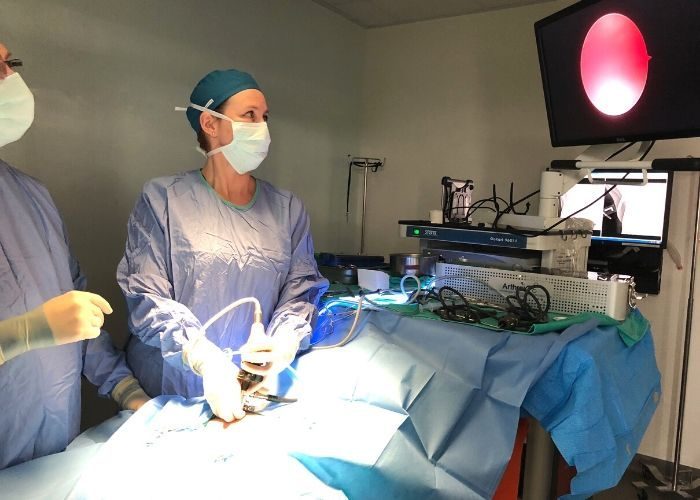
The resources provided by CARE are designed to help you diagnose developmental orthopedic diseases and OA and develop long-term treatment plans for your patients. However, sometimes referral to a surgeon or rehabilitation professional may be indicated. One of the primary goals of CARE is to nurture the relationship between primary care veterinarians and veterinary specialists.
*A note on veterinary rehabilitation: Unless you plan to continue to recheck your patient frequently (every 2-4 weeks) to adjust pain medications, discuss nutrition, and other supplements, you will want to refer to a veterinarian that is certified in rehabilitation.
This is very important for patients that require pain management. A veterinarian should diagnose and design a treatment plan for the patient, which can then be followed by a licensed technician. Each state will have different practice laws for the supervision of rehabilitation. But it is in your patient’s best interest to have a veterinarian involved in their care. (Find ones near you on RehabVets.org).
Human physical therapist trained in canine rehabilitation can also provide valuable service for dogs with OA. However, they will not be able to prescribe medications or perform radiographs. The ideal team is a veterinarian and PT working together.
A Diplomate of the American College of Veterinary Sports Medicine and Rehabilitation (DACVSMR) is a board-certified specialist in physical medicine. These specialists have undergone residency training, conducted research, and passed a grueling 2-day examination. Rehab/sports med specialists will often be able to provide a complete diagnostic workup and thorough treatment plan for dogs with OA (Learn more on VSMR.org)
Swim spaws or other facilities that provide hydrotherapy that are not operated by a veterinarian or physical therapist generally have the dog’s best interest in mind. These facilities could potentially be useful as a site for general exercise and conditioning in a low-impact environment. But, it is crucial to differentiate between true veterinary rehabilitation and services provided by lay-individuals when making recommendations for your patients, particularly when a diagnosis and treatment plan is needed. Your clients will need your assistance in making this distinction.
Here are some tips on when and where to refer your patients with DOD or OA.
When: If you just hate orthopedics!
It’s OK! We can’t keep up with every aspect of veterinary medicine enough to feel confidence or love for every discipline. If ortho just isn’t your thing, don’t worry. As an advocate for your patient, if you suspect that they have pain or arthritis and need more of a workup or treatment plan, it is OK to refer them to someone who loves orthopedics and arthritis management.
Where: Your local surgeon, rehabilitation veterinarian, or sports medicine specialists.
- If diagnostics such as radiographs or CT are indicated to establish a diagnosis, you will likely need to refer to a specialty hospital with a surgeon or rehab/sports medicine specialists. Many rehabilitation practices do not have on-site diagnostics.
- Surgeons will be able to establish a diagnosis and, if indicated, offer surgical options. But most surgeons are not interested in providing long-term pain management and arthritis recommendations that do not involve surgery. This is where rehabilitation veterinarians can play a valuable role. Get to know your local surgeons and rehab vets to learn their philosophies, interests, and ask how you can best work together to help your patients. (You can find local resources at ACVS.org and RehabVets.org).
When:
- You have diagnosed hip dysplasia in a 16-week old puppy based on positive Ortolani
-
Where:
- Your local surgeon that performs Penn Hip exam and Juvenile Pubic Symphysiodesis (Learn more about these in Early Diagnosis).
When:
- You have diagnosed hip dysplasia in a 6-month-old dog.
-
Where:
- Your local surgeon to discuss whether the patient is a candidate for Triple Pelvic Osteotomy (TPO).
When:
- Your 6-month-old patient with hip dysplasia is not a candidate for TPO.
-
Where:
- Your local rehabilitation veterinarian to work on strengthening of the pelvic limb muscles and management of lean body condition.
When:
- You have diagnosed hip OA in an 8-year-old dog that is overweight.
-
Where:
- Your local rehabilitation veterinarian.
When:
- You have diagnosed elbow dysplasia in a 6-month-old dog.
-
Where:
- Your local surgeon who will discuss CT, arthroscopy, and surgery.
When:
- You have diagnosed elbow OA in a 7-year-old dog; this dog has had previous surgery and been chronically lame.
-
Where:
- Your local rehabilitation veterinarian.
When:
- You have diagnosed arthritis of the digits.
-
Where:
- Your local rehabilitation veterinarian.
When:
- You have diagnosed chronic OA of the tarsus in an 8-year-old dog.
-
Where:
- Your local rehabilitation veterinarian.
When:
- You have diagnosed a partial or complete CCL sprain (Read more about that here).
-
Where:
- Your local board-certified surgeon to discuss surgical stabilization of the stifle. Surgery is the most effective and fastest way of treating CCL disease and returning a dog to activity. When performed by an experienced surgeon, the risks of surgery are very small. The surgeon will discuss the pros/ cons of surgery with your client. You can also direct them to (tploinfo.com) to learn more.
When:
- The client of your patient with a CCL sprain is not able/ willing/ interested in pursuing surgery
-
Where:
- Your local rehabilitation veterinarian.