
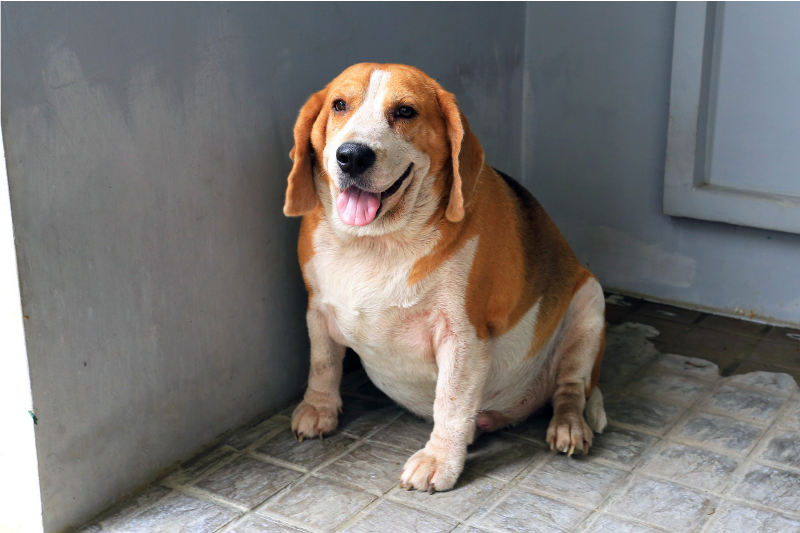
There is no aspect of OA management more important than weight management. It has been estimated that nearly 60% of dogs are overweight, and being overweight predisposes dogs to numerous serious or life-threatening conditions such as:
- Osteoarthritis
- Diabetes
- High blood pressure
- Heart disease
- Respiratory disease (especially brachycephalic breeds!)
- Cranial Cruciate Ligament injury
- Higher risks with anesthesia
- Kidney disease
- Skin disorders
- Reduced immune function
- Many forms of cancer
Risk factors for obesity:
- Genetics/ breed:
- Labradors, Goldens, Rottweilers, Dachshunds, Bulldogs (French and English), Shelties, mix breeds (there are more…)
- Spay/ neuter status:
- Spayed and neutered dogs are 2x as likely to be overweight as intact female and male dogs. Metabolism decreases by 20-30% following gonadectomy while appetite increases.
- Age:
- With age comes the loss of lean muscle and increased deposition of fat; risk for increased body weight/ BCS increases with age.
- Activity:
- Not shocking, but reduced activity increases the risk of weight gain.
- Free choice feeding
- Keeping the food bowl full vs. meal feeding leads to weight gain. Advise clients against this practice!
- High-calorie treats and high-fat food:
- Fat has a higher caloric density per gram (compared to protein and carbohydrates). Feeding too many treats leads to excessive calorie intake. {Treats do not need to be excluded, see below (tools for compliance link) to learn about proper treat allowance and the calorie content of different treats)}
Numerous studies have shown the impact that weight loss or maintenance of a lean body condition can have on symptoms of OA in dogs. The majority of weight loss should come from caloric restriction; however, the addition of exercise does improve weight loss and maintenance of muscle (which dogs with OA need!).
Examples of studies looking at caloric restriction alone:
- Reduced symptoms of OA with as little as 6% weight loss. Client-owned dogs that were at least 20% overweight with hip or elbow OA were placed on a calorie-restricted diet for 18 weeks with the aim of 0.5-1% weight loss per week. No NSAIDs were allowed and no change in activity level. Lameness started to improve after 4 weeks, with about 50% improvement in lameness by 6 weeks and 80% improvement by the end of the study. (Marshall W et al. VCOT 2009)
- Significantly reduced lameness in client-owned dogs with hip OA that achieved 11-18% weight loss. These dogs were placed on a weight loss diet with caloric requirement calculated to 60% of current body weight. Dogs did not receive any NSAIDs or other drugs or supplements and did not have any change in their exercise. (Impellizeri JA et al. JAVMA 2000)
- Dogs at risk of OA should maintain a BCS of ~4.5/9. Health risks increase at a BCS >6.5/9. Labrador retriever puppies with a genetic predisposition for hip dysplasia were divided into 2 groups: one group fed to maintain BCS of ~4.5/9 (limit fed) while the other group was fed 25% more calories (control fed, BCS ~ 6.5/9). Dogs in the limit-fed group developed radiographic signs of OA at 12 years of age, while control fed dogs developed radiographic OA at 6 years. Limit-fed dogs took twice as long to develop radiographic OA in their hips! And…limit fed dogs lived on average 2 years longer! (Kealy RD et al. JAVMA 2000; Smith GK et al. JAVMA 2006; Lawler DF et al. JAVMA 2005.)
Examples of studies looking at caloric restriction plus exercise:
- Exercise helps achieve weight loss, but accountability helps even more. Client-owned dogs with OA that were overweight or obese were put on a weight loss diet and given a home exercise program that included walking 20 minutes, 3x/day as well as massage and passive range of motion. Half of the dogs also came into the clinic twice a week for the first 2 months for weigh-ins, review of the home program, and TENS treatment to the affected joint (this is a passive therapy and does not burn calories). After 6 months, all dogs lost weight, but dogs that came into the clinic in the first 2 months lost significantly more weight (13.6 vs 9.3%). All dogs had reduced pain and lameness throughout the study, with the dogs that lost more weight showing less lameness. Increased owner compliance may have resulted in the difference between groups. (Mlacnik E et al JAVMA 2006)
- Underwater treadmill therapy may help with weight loss. Client-owned dogs that were obese were placed on a calorie-restricted diet and participated in an exercise program that included leash walking at home at least once a day, obedience class, and underwater treadmill (no set schedule or protocol, but an average of 13 sessions). After 3 months, the average amount of weight loss was 18.9% of starting body weight (1.5%/ week). Body condition as measured by thoracic and abdominal girth also declined. (Chauvet A et al. Can Vet J 2011)
- Exercise preserves lean body mass with calorie restriction weight loss. Client-owned dogs that were overweight and considered sedentary were placed on a calorie-restricted diet. One group did not change their exercise level, while the other group participated in a clinic-based fitness training (UWTM plus land treadmill) for 1 hour, 3x/ week. After 12 weeks, dogs in both groups lost weight; dogs in the fitness training group lost a larger amount of weight (13.9 vs. 12.9%) and importantly, maintained a lean body mass (ie muscle) compared to the calorie restriction only group which lost muscle mass. (Vitger AD et al. JAVMA 2016)
Barriers to Weight Loss
We recognize that weight loss is important, but how do we convey this importance to our clients? And furthermore, how can we help them be compliant in following a weight loss plan?
According to a 2019 report from Banfield, 80% of veterinarians view owner compliance as the largest barrier to weight loss in animals with OA. Other barriers included the cost of a veterinary diet and owners denial that their pet is overweight (one study found that about 40% of clients with overweight dogs thought their dog was an ideal body weight).
Of note, 50% of responding veterinarians indicated that a primary barrier was that they did not have enough time to spend educating their clients on the importance of weight loss. This is why we created CARE! CARE is here to help finish the conversation that you started and provide tools that can help clients stay compliant and reach the goals that you have set.
3 Steps to Client Compliance for Weight Loss
Step 1: Clear plan
Just saying “Your dog needs to lose weight, you should cut back on the amount you feed” is not going to do the trick. Clients need a plan that is Clear, Customized, and Realistic.
The plan must include a diet recommendation. There has never been a more confusing time to be a veterinarian making recommendations for food. Between human nutritional trends, client pressures, marketing tactics, and food recalls, it can truly be hard to have a discussion around food. But results from the Association of Pet Obesity Prevention Pet Obesity Survey (2017) found that dog owners want us to make a diet recommendation.
What should we recommend?
But, what diet do we recommend? Virtually all of the studies on weight loss and nutritional requirements for dogs have been done using kibble products produced by one of the “big” manufacturers such as Royal Canin, Hills or Purina.
We are very fortunate to have the data that has come out of these studies. However, a lack of research does not equate to lack of efficacy. So, would a home-cooked or commercially available cooked, freeze-dried, or raw diet also provide nutrition and achieve weight loss? The data is not in yet.
There is not a single right or best food out there. We must work with clients to find the right food that fits their dog’s medical needs and their budget and lifestyle.
The guidelines I suggest when making a diet recommendation are:
First, figure out where all of the calories the dog is getting are coming from and the dog’s current daily caloric intake. Some owners and well-meaning vets may have no idea how many calories are things like marrow bones or bully sticks.
Second, figure out the dog’s daily caloric requirement or caloric deficit required. Use this tool to help calculate the caloric requirements.
Then, figure out how many calories are in the food that is being fed. If it is very calorie-dense (typically high in fat), then the dog will need a smaller volume, and this runs into the problem of “I only feed my dog ½ a cup and they still look starving.”
- Seek out higher protein foods with lower fat content.
- Give an allowance for treats! Treats are going to happen, so you might as well give the client guidelines for which treats to feed and how many.
- The Plan must include clear instructions on how much to feed. This is an ideal role for a technician nutrition advocate!
Calculate the recommended daily caloric intake based on ideal body weight (hint: the calorie calculator linked above will do this for you).
- Figure out ideal body weight by finding % overweight using BCS:
- Each point above 5 on 1-9 scale = 10% overweight
- Using the IDEAL BW, figure out the Resting Energy Requirement:
- BW(in kg)0.75 x 70 = RER
- For weight loss, multiply RER by 0.8 (feed 80% of RER)
- Once the target weight is achieved, then the dog can be fed full RER.
Step 2: Accountability
There is a reason why Weight Watchers and other human diets have meetings and support groups—going on a diet is hard and everyone needs help and accountability! Make sure your clients know that you and your team are supporting them.
The best way to do this is to schedule weekly weigh-ins. This should take no DVM or tech time, simply have the client stop by your clinic and weigh their dog on your lobby scale once a week. They can then report the weight to your CSR, who then enters the weight in the patient’s record. This trip also reinforces that vet visits dont have to be stressful.
Building habits takes time
Remind clients that it takes 3 weeks (21 days) to build a habit. Have them commit to the first 3 weeks of the diet and new exercise plan; check in with them regularly throughout this initial 3 weeks and celebrate the small successes that should come in this period.
In addition to weekly weigh-ins and first-3-week check-ins, be sure to schedule recheck examinations every 4 weeks to be sure that the recommended calories and diet are working. Remember, the goal is 0.5- 1% weight loss per week.
If this is not happening, you need to figure out why! Interview the owner about how things are going (without being judgmental), recalculate calories and adjust the plan, potentially considering a different food.
Step 3: Celebrate success
Weight loss is not meant to happen quickly (in order to be safe and lasting), which means that clients can become frustrated by not seeing immediate results. Be sure to celebrate each week of weight loss. This is where weekly weigh-ins and the weight loss tracking form can really help everyone see the big picture.
When the end goal is met, this is a huge (pun not intended) deal! Be sure to let your client know how proud of them you are and that you recognize how hard they (and their dog) worked to get here. This is the time for the entire hospital to show their support for the client and dog. Be creative—have a party, post on social media, make this client feel extra special!
The yo-yo diet is a real thing. For pets too. The plan does not stop once the target weight/ BCS is reached, you must provide a plan for maintaining the dog’s new body condition. Should they stay on the same food? Can the calories be increased?
In theory, the calories can be increased to a maintenance level once the caloric deficit is no longer needed. But this is a time that weekly weigh-ins must continue! If the dog can maintain their ideal weight with the increased amount of food for 4 weeks, then you can start backing off the frequency of weigh-ins. But make sure that the client understands how to monitor their dog’s body condition and adjust the amount they feed each day based on the dog’s activity level.
In summary, weight loss is THE most important aspect of managing OA and keeping dogs healthy throughout their life.
References
Brooks D, Churchill J, Fein K, et al. 2014 AAHA Weight Management Guidelines for Dogs and Cats. J Am Anim Hosp Assoc 2014; 50:1-11.
Felson DT, Chaisson CE: Understanding the relationship between body weight and osteoarthritis. Ballieres clin Rheumatol 11: 671-681, 1997.
Marshall WG, Hazewinkel HAW, Mullen D, et al. The effect of weight loss on lameness in obese dogs with osteoarthritis. Vet Res Commun 2010;34:241-253.
Marshall WG, Bockstahler BA, Hulse DA and Carmichael S. A review of osteoarthritis and obesity: current understanding of the relationship and benefit of obesity treatment and prevention in the dog. Vet Comp Orthop Trauamatol 2009;22:339-345.
Impellizeri JA, Tetrick MA, Muir P: Effect of weight reduction on clinical signs of lameness in dogs with hip osteoarthritis. J Am Vet Med Assoc 216: 1089-1091, 2000.
Lawler DF, Evans RH, Larson BT, et al. Influence of lifetime food restriction on causes, time, and predictors of death in dogs. J Am Vet Med Assoc 2005;226:225-231.
Kealy RD, Lawler DF, Ballam JM, et al. Evaluation of the effect of limited food consumption on radiographic evidence of osteoarthritis in dogs. JAVMA 2000.
Smith GK, Paster ER, Powers MY, et al. Lifelong diet restriction and radiographic evidence of osteoarthritis of the hip joint in dogs. JAVMA 2006
Mlacnik E, Bockstahler BA, Muller M, et al. Effects of caloric restriction and a moderate or intense physiotherapy program for treatment of lameness in overweight dogs with osteoarthritis. J Am Vet Med Assoc 2006;229:1756-1760.
Chauvet A, Laclair J, Elliott DA, German AJ. Incorporation of exercise, using an underwater treadmill, and active client education into a weight management program for obese dogs. 52(5):491-496, 2011.
Vitger AD, Stallknecht BM, Nielsen DH, Bjornvad CR. Integration of a physical training program in a weight loss plan for overweight pet dogs. J Am Vet Med Assoc 2016;248:174-182.
German AJ. Weight management in obese pets: the tailoring concept and how it can improve results. Acta Vet Scand 2016;58:57.
Glanagan J, Bissot T, Hours MA, et al. Success of a weight loss plan for overweight dogs: The results of an international weight loss study. PLOS One 2017 https://doi.org/10.1371/journal.pone.0184199