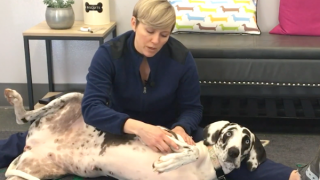
Rehabilitation

Canine Sports Medicine and Rehabilitation

Summary:

The book covers a wealth of topics related to sports medicine and rehabilitation.

Author & Journal:Zink MC, et al, eds. Wiley-Blackwell Publishing, Chichester, UK. 2013

Kinematic motion analysis of the joints of the forelimbs and hind limbs of dogs during walking exercise regimens.

Summary:

To assess forelimbs and hind limb joint kinematics in dogs during walking on an inclined slope (uphill), on a declined slope (downhill), or over low obstacles (cavaletti) on a horizontal surface and compare findings with data acquired during unimpeded walkingon a horizontal surface.

Conclusion:

These evidence-based data indicated that each evaluated exercise, except for downhill walking, has a specific therapeutic value in physical therapy for dogs.

Author & Journal:Holler PJ, et al, Am J Vet Res 71(7):734-740, 2010

The thermal effects of therapeutic lasers with 810 and 904 nm wavelengths on human skin.

Summary:

To investigate the effect of therapeutic infrared class 3B laser irradiation on skin temperature in healthy participants of differing skin color, age, and gender.

Conclusion:

The thermal effects of LLLT at doses recommended by WALT-guidelines for musculoskeletal and inflammatory conditions are negligible (<1.5°C) in light, medium, and dark skin. However, higher LLLT doses delivered with a strong 3B laser (200 mW) are capable of increasing skin temperature significantly and these photothermal effects may exceed the thermal pain threshold for humans with dark skin color.

Author & Journal:Joensen J, et al, Photomed Laser Surg 2011:29(3):145-153

Rehabilitation of dogs with surgically treated cranial cruciate ligament-deficient stifles by use of electrical stimulation of muscles.

Summary:

To determine effect of electrical muscle stimulation (EMS) on rate and degree of return to function of the limb and development of degenerative joint disease (DJD) after surgical creation and subsequent stabilization of the cranial cruciate ligament(CrCL)-deficient stifle.

Conclusion:

Improved lameness scores, larger thigh circumference, and decreased radiographically apparent bony changes observed for the treated group of dogs support the hypothesis that dogs treated by EMS after surgical stabilization of the CrCL-deficientstifle had improved limb function, with less DJD, than did dogs treated with the currently accepted clinical protocol of cage rest and slow return to normal activity. However, results of force plate evaluation did not support the hypothesis. Increased meniscal damage in dogstreated by EMS may be cause for concern.

Author & Journal:Johnson JM, et al, Am J Vet Res 58:1473-1478, 1997

The role of exercise and physical modalities in the treatment of osteoarthritis.

Summary:

Physical rehabilitation is a valuable and often underutilized part of the overall management of small animals with OA. A team consisting of the veterinarian, physical therapist, veterinary technician, and owner is vital to determine and carry out an appropriate therapeutic regimen.

Conclusion:

To maintain enthusiasm for the program, measurements should be regularly obtained to document progress. In addition, controlled studies should be performed to determine the degree of improvement that may be expected with physical rehabilitationprograms.

Author & Journal:Millis DL, et al, Vet Clin North Am Small Anim Pract 27(4):913-930, 1997

Kinematic analysis of the hind limb during swimming and walking in healthy dogs and dogs with surgically corrected cranial cruciate ligament rupture.

Summary:

To determine hip, stifle, and tarsal joint ranges of motion (ROM) and angular velocities during swimming and walking in healthy dogs and dogs with surgically corrected cranial cruciate ligament (CCL) rupture.

Conclusion:

Results suggested that following surgical management of a ruptured CCL in dogs, swimming resulted in greater ROM of the stifle and tarsal joints than did walking. This suggests that if ROM is a factor in the rate or extent of return to function in these dogs, then aquatic rehabilitation would likely result in a better overall outcome than walking alone.

Author & Journal:Marsolais GS, et al, J Am Vet Med Assoc 222(6):739-743, 2003

Effect of Pulsing in Low-Level Light Therapy

Summary:

Low level light (or laser) therapy (LLLT) is a rapidly growing modality used in physical therapy, chiropractic, sports medicine and increasingly in mainstream medicine. LLLT is used to increase wound healing and tissue regeneration, to relieve pain and inflammation, to prevent tissue death, to mitigate degeneration in many neurological indications. While some agreement has emerged on the best wavelengths of light and a range of acceptable dosages to be used (irradiance and fluence), there is no agreement on whether continuous wave or pulsed light is best and on what factors govern the pulse parameters to be chosen.

Conclusion:

There is some evidence that pulsed light does have effects that are different from those of continuous wave light. However further work is needed to define these effects for different disease conditions and pulse structures.

Author & Journal:Hashmi JT, et al, Lasers Surg Med 2010;42:450-466

Extracorporeal shock wave therapy improves short-term limb use after canine tibial plateau leveling osteotomy

Summary:

To determine the influence of postoperative extracorporeal shock wave therapy (ESWT) on hind limb use after tibial plateau leveling osteotomy (TPLO).

Conclusion:

CONCLUSION:
Weight bearing increased faster after TPLO in dogs treated with postoperative ESWT.

RESULTS: The PVF (5.5 ± 1.0 N/kg, mean ± SD) and VI (0.67 ± 0.14 N-s/kg) of surgically treated limbs in the ESWT cohort were higher 8 weeks after surgery compared with preoperative (3.8 ± 1.1 N/kg, P < .0001 and 0.47 ± 0.21 N-s/kg, P = .0012, respectively) values. In the control cohort, PVF (2.9 ± 1.3 N/kg, P = .0001) and VI (0.33 ± 0.20 N-s/kg, P = .0003) 2 weeks after surgery and VI (0.42 ± 0.2 N-s/kg, P = .0012) 8 weeks after surgery were lower (4.59 ± 2.33 N/kg and 0.592 ± 0.35 N-s/kg, respectively) than before surgery. Other parameters did not differ between groups.

Author & Journal:Barnes, Kate et al, Vet Surg. 2019 Aug 30. doi: 10.1111/vsu.13320