
Shock Wave Therapy for Dogs with Arthritis: What Pet Owners and Veterinary Teams Should Know
If your dog has osteoarthritis (OA), you’ve probably heard that there’s no single fix. That’s true. The dogs who do best usually have a plan built from several strategies working together: weight management, the right kind of exercise, pain medication when needed, changes at home, and rehabilitation. Shock wave therapy is one of the tools that can be part of that plan. Here’s what it is, what the research does and doesn’t show, and how to decide whether it’s worth a conversation with your veterinary team.
First, a quick word about arthritis in dogs
Many people think of arthritis as an old-dog problem, but it often starts much earlier. In dogs, OA is frequently the result of an underlying orthopedic issue such as hip or elbow dysplasia or cruciate ligament disease. Research from NC State University found that about 40% of dogs between 8 months and 4 years old had X-ray evidence of OA, and more than half of those dogs showed clinical signs.
OA also tends to feed itself. A painful joint leads to less activity, less activity leads to muscle loss, and muscle loss leads to more stress on the joint. The goal of treatment is to interrupt that cycle so your dog can keep moving comfortably.
What is shock wave therapy?
Despite the name, shock wave therapy has nothing to do with electricity. It uses high-energy acoustic (sound) pulses delivered through the skin into targeted tissue. The treatment is non-invasive, meaning no needles or incisions, and it’s designed to trigger a biological response in the treated area.
Researchers are still working out exactly how it works, but the observed effects include reduced inflammatory activity, improved local blood flow, stimulation of the body’s repair processes, and pain relief. That combination matters for OA, which involves both inflammation and loss of function.
There are two broad types of shock wave devices. Focused shock wave concentrates energy at a specific depth in the tissue, while radial pressure wave devices spread lower energy more superficially. Your veterinary team can explain which type they use and why.
What a treatment session looks like
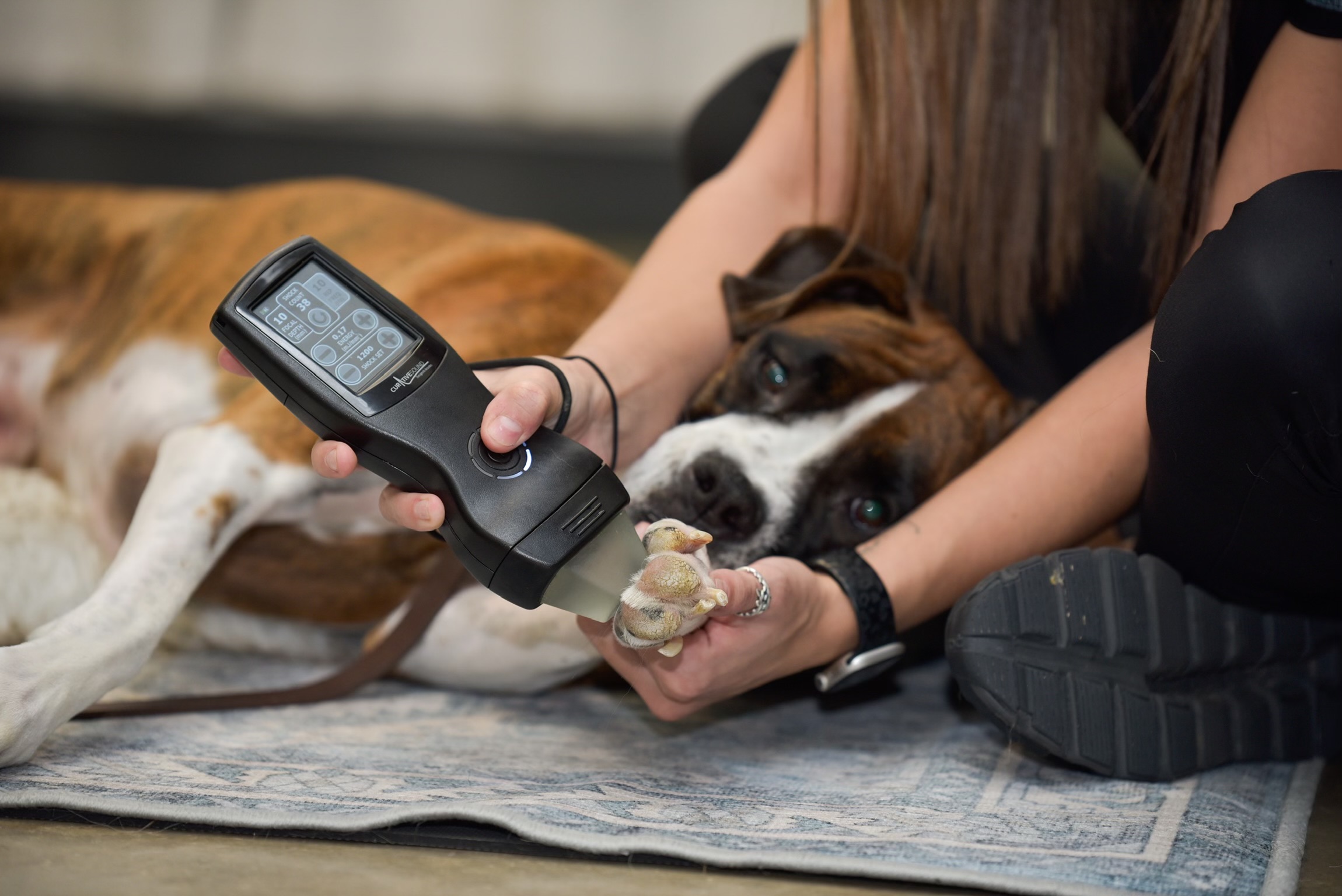
For pet parents wondering what to expect, a typical visit is fairly simple. The hair over the treatment area may be clipped, ultrasound gel is applied, and the veterinarian or rehab professional moves a handheld applicator over the joint. Sessions are usually short.
Older, louder devices often required sedation. Many newer devices are quieter and better tolerated, so many dogs can be treated while awake, though this depends on the dog’s temperament, the joint being treated, and the device. Some dogs may be a little sore or tender afterward, and your veterinary team will explain what to watch for and whether to adjust activity in the days after treatment.
Shock wave isn’t right for every dog or every area of the body. Your veterinarian will screen for situations where it should be avoided and will confirm that your dog’s pain is actually coming from OA before recommending it.
For veterinary teams: integrating shock wave into an OA plan
Shock wave works best when it’s positioned as an adjunct within a structured, stage-appropriate plan rather than a standalone treatment.
Confirm the diagnosis first. Radiographic OA and clinical OA don’t always align. Gait evaluation, joint palpation, range of motion, and muscle symmetry, alongside imaging, help ensure treatment targets the true source of pain. Staging tools such as COAST and resources like the CARE OA Blueprint support consistent decisions and clearer client communication.
Match the tool to the stage. For at-risk and preclinical patients, the focus is baseline management and monitoring. For clinical OA with pain, shock wave can be considered alongside pain control. For recurrent or persistent cases, it can be used strategically with rehabilitation and other modalities. In advanced OA, the priority shifts to comfort, function, and realistic expectations.
Protocols vary. Treatment procedures differ by device, location, and patient, but in OA cases clinicians commonly use roughly 1,500 to 3,000 pulses per treatment, with sessions spaced one to two weeks apart for a series of three to four treatments. Some patients benefit from later maintenance or flare-up sessions. Energy settings and depth targeting should follow the manufacturer’s guidance and clinical judgment.
It plays well with others. Shock wave can generally be combined with NSAIDs, rehabilitation, and biologic therapies such as PRP depending on case selection. For patients in an active flare, pain management takes priority, and shock wave therapy can play a key role.
Questions to ask your veterinarian
If you think shock wave therapy might help your dog, these questions can guide the conversation.
- Is my dog’s discomfort confirmed as coming from OA, and which joints are involved?
- Where could shock wave fit alongside my dog’s current plan?
- How many sessions do you expect, and how will we measure whether it’s working?
- Will my dog need sedation?
- What should I watch for after treatment?
If your clinic doesn’t offer shock wave, a certified rehabilitation professional may. CARE’s Find a Rehab Vet link is a good place to start.
Tracking progress at home
Because OA changes gradually, it helps to track how your dog is doing. A simple approach is to mark each day as a good day, an okay day, or a bad day. Over a few weeks, patterns emerge that can show whether a treatment is helping and when it’s time for a recheck. Bring your notes to appointments; they make follow-up conversations far more productive.
The bottom line
Shock wave therapy isn’t a cure for arthritis, and it doesn’t replace the foundations of good OA care. But for the right dog, as part of a thoughtful multimodal plan, it’s a non-invasive option that may reduce pain, improve mobility, and help keep your dog doing the things you love together.
About the sponsor: Curative Sound develops focused shock wave therapy devices for veterinary practices. Learn more at curative-sound.com.
References
- Enomoto M, et al. Prevalence of radiographic appendicular osteoarthritis and associated clinical signs in young dogs. Sci Rep. 2024. (PMC10838335)
- Souza AN, et al. Radial shock wave therapy in dogs with hip osteoarthritis. Vet Comp Orthop Traumatol. 2016;29(2):108-114.
- Dahlberg J, et al. The evaluation of extracorporeal shockwave therapy in naturally occurring osteoarthritis of the stifle joint in dogs. Vet Comp Orthop Traumatol. 2005;18:147-152.