
Librela was introduced into the European veterinary market in 2021, and in Canada and the US in 2023. Since then, veterinarians around the world have witnessed often dramatic pain control and improved mobility in their patients after starting Librela. Librela truly has been a life-changing, and at times life-saving, medication for countless dogs and an important tool in the OA management toolbox. To learn more about what Librela is and how it works, read this article.
While appreciating the benefits of Librela over the last few years, we also have had the opportunity to recognize that there are uncommon side effects that were not expected based on the initial pre-approval studies and early experience programs. These include vomiting and diarrhea, neurologic issues, including ataxia, paresis and proprioception deficits, and new or worsening lameness. This last side effect is the topic of this article.
Do dogs get RPOA?
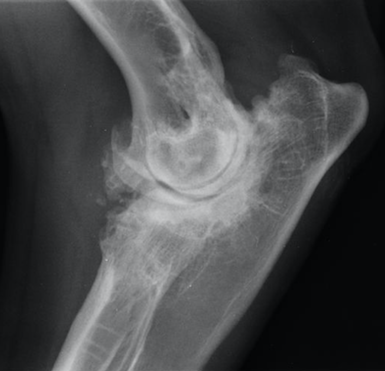
Librela has been linked with accelerated progression of arthritis with potentially devastating consequences for effected joints. This condition appears to be similar to Rapidly Progressive Osteoarthritis (RPOA) described in humans and associated with anti-NGF mAb use in people. In the last year, several case reports have been published describing RPOA-like radiographic changes in dogs following Librela administration. Note: the radiographic image above does not represent RPOA, this is an example of “expected” elbow OA. See the references below for radiographic images of RPOA-like conditions in dogs.
While it is clear that RPOA-like changes can indeed be associated with Librela use, i.e. Nerve Growth Factor inhibition, there remain some important unanswered questions.
These include:
- How often do these side effects occur?
It would be ideal to know what percentage of dogs will develop Librela-associated RPOA-like joint destruction. In other words, out of 10,000 dogs that receive Librela, how many would be expected to develop RPOA-like changes. We don’t know this answer yet, though the percentage appears to be very low. There have been approximately 200 reported cases of accelerated/ abnormal arthritis progression. This number likely underrepresents the true incidence since some cases go unreported. It is impossible to know how many dogs worldwide have received Librela, but according to the manufacture, over 40 million doses have been sold as of mid-2026, and an estimated 1 million dogs treated in the US. So while we do not know the true numerator or denominator to calculate the incidence of RPOA-like joint disease, the risk, while present, appears to be quite low.
- Which dogs are at risk?
At this time there is not a breed, age or body weight that appears to be more at risk. The joints that seem to be most commonly affected are the elbow and tarsus, though there have been reports of the condition occurring in all appendicular joints.
- Is the risk of RPOA-like joint disease worse with longer term use?
Maybe? In the Budsberg, et al. 2026 publication, the average number of Librela doses that dogs received was 17, though there have been reports of RPOA-like signs developing after only 1 month and up to 64 months of treatment.
- Does the use of NSAIDs along with Librela increase the risk?
Maybe. In humans, the development of RPOA is linked with concurrent NSAID use, especially long-term NSAIDs (>90 days). In the RPOA-like veterinary reports, approximately 60% of dogs were receiving concurrent NSAIDs, but it is not clear from the retrospective data whether this was continuous or PRN dosing.
- What can I do to decrease the risk of RPOA-like joint disease occurring in my patient/ dog?
This may be where the biggest frustration for veterinarians lies… we do not yet know how to reduce the risk of this condition in the same way we know how best to use NSAIDs to reduce side effects. However, the following guidelines may be helpful until we learn more:
o Perform a complete orthopedic exam and a neurologic screening exam and confirm a diagnosis of osteoarthritis prior to starting Librela.
o Do not use Librela in joints that are unstable or in place of conditions for which surgery or other therapy is indicated (CCL disease, IMPA, neurologic disease).
o Obtain baseline radiographs prior to starting Librela.
o Provide guidance on gradual increase in activity and incorporate rehabilitation exercises that strengthen periarticular muscles and improve proprioception.
o Recheck patients regularly. If any new lameness or joint swelling develops, obtain radiographs.
o Use caution or avoid concurrent use with NSAIDs unless absolutely necessary for pain control.
Take home points:
- If a patient is in pain, the pain must be managed; doing nothing or using unproven therapies is not an option. The optimal pain management plan will differ between patients based on diagnosis, severity of pain, comorbidities, concurrent medications, ability to take/dose oral medications, owner compliance, owner finances, and more.
- Librela remains an important tool in the OA toolbox. All medications have potential risks and side effects. Use of Librela should be based on a risk/benefit analysis and discussion with the caregiver.
- Librela should only be used once a thorough diagnosis is established. Baseline radiographs are strongly recommended.
- Patients should be monitored and any new lameness or joint swelling should trigger radiographs.
- If any side effects (RPOA-like or otherwise) are suspected, they should be reported to Zoetis and/or the local regulatory agency (FDA in the US). In the US you can report directly to the FDA by calling 1-888-FDA-VETS. You can contact your Zoetis representative or in the US, call 1-888-963-8471 or email [email protected]. It is very important that you report any potential side effects from any medication to the manufacture or FDA- this is true even for drugs that have been out for a long time.
References
Budsberg SC, Clements DN, Regan DP, Wennemuth J. Atypical radiographic changes seen in dogs treated with bedinvetmab (Librela). J Am Vet Med Assoc. 2026 Aug 31:1-9. doi: 10.2460/javma.26.05.0379. Epub ahead of print. PMID: 42673999. https://avmajournals.avma.org/view/journals/javma/aop/javma.26.05.0379/javma.26.05.0379.xml
Farrell M., Waibel F.W.A., Carrera I., et al., (2025) Musculoskeletal adverse events in dogs receiving bedinvetmab (Librela). Front Vet Sci 12:1581490. https://www.frontiersin.org/journals/veterinary-science/articles/10.3389/fvets.2025.1581490/full
von Pfeil DJF, Adams RJ, Clark L, Dewey CW, Brunke MW, Garner M, Lanz OI, Miller N, Breshears L, Déjardin LM, Armitage A, Hayashi K, Vezzoni A. Bedinvetmab (Librela/Beransa) in dogs raises safety concerns, including rapidly progressive osteoarthritis, and warrants vigilant adverse event reporting. J Am Vet Med Assoc. 2026 Jun 26:1-11. doi: 10.2460/javma.26.03.0170. Epub ahead of print. PMID: 42361372. https://avmajournals.avma.org/view/journals/javma/aop/javma.26.03.0170/javma.26.03.0170.xml
FDA Standard Adverse Event Review
Monteiro, B.P., Simon A., Knesl O., et al. (2025) Global pharmocovigilence reporting of the first monoclonal antibody for canine osteoarthritis: a case study with bedinvetmab (Librela). Front Vet Sci, 12.https://www.frontiersin.org/journals/veterinary-science/articles/10.3389/fvets.2025.1558222/full