
The saying goes that “you can’t build a great building on a weak foundation” and this is exactly how we should be thinking when it comes to our dog’s posture. A house which is built on a poor foundation will eventually suffer issues if not rectified and this runs true for our dogs as well.
The research tells us that many of our beloved breeds have specific genetic predispositions to orthopaedic conditions or injury and this means there is a higher likelihood of those injuries occurring. But that is not the whole picture as a dog’s nutrition, environment, exercise, and fitness levels all play a significant role in their risk of injury. This is where proactive measures like improving posture come in.
As a dog owner, learning to identify, monitor, and improve your dog’s posture can be a powerful tool for injury prevention. It also gives you a chance to spot potential issues early on. You don’t need a champion show dog or fancy equipment to make a difference, just 5-10 minutes a day of consistent, targeted postural exercises can yield remarkable benefits for your dog’s long-term well-being.
Good vs bad posture
It is important that we consider each breed’s typical shape when assessing posture, as what is normal for a greyhound might be abnormal for a terrier for example; to check this, head to your country’s Kennel Club for more information on what is to be expected as ‘normal’ for your dog. When assessing your dog in standing, look for the following general signs of poor posture:
- Rounding or curvature of the spine
- Curvature of the legs either outwards or inwards
- Turning of the feet either outwards or inwards
- Low positioning of the neck
- Differences in paw shapes (i.e. one is more splayed than the other)
When assessing your dog in a sit, look for the following general signs of poor posture:
- Rounding or curvature of the spine
- Sitting with the back legs very wide
- Turning of the legs outwards or inwards
- Sitting with back legs to one side consistently
- Sitting with back legs extended out in front of them
When assessing your dog in a down, look for the following general signs of poor posture:
- Rounding or curvature of the spine
- Lying with back legs to one side consistently
- Lying with the back legs very wide
- Lying with back legs extended out in front of them
It is always advisable to seek professional help if you believe your dog shows any signs of poor posture, either from veterinarians or canine professionals such as veterinary physiotherapists. The following exercises may be suggested for those who have no diagnosed conditions and who have been assessed by a qualified professional.
(Emma Joyce Photography)
Targeted standing
Here we start at the basics by teaching our dogs to stand correctly. Again, ‘natural’ standing posture differs between breeds so it’s best to research into what your dog should look like specifically. The following general points make a good standing posture:
- Front legs are ‘stacked’ underneath the shoulders
- The back is flat (except in some breeds)
- Limbs are facing forwards
- All paws are evenly spaced apart- not too wide, not too narrow
The easiest way to encourage this is to use a treat to lure the dog out of a sitting posture without letting them take steps forwards. Teaching your dog paw targets can help with this process if needed.
Tidy sitting
Poor sitting posture is often termed ‘sloppy sitting’ and is commonly seen with orthopaedic conditions in dogs. After assessment, tidy sitting exercises may be recommended as this provides the basis of some of the beneficial exercises we can prescribe as rehab professionals.
The easiest way to encourage this is to position your dog against a wall with their ‘weakest’ hind leg closest and ask them to sit. This encourages them to keep this leg close to the body. If your dog needs extra help, or is ‘untidy’ with both hind legs, you may need to assist your dog into the sit by placing your hands over their thighs as they sit, applying a very light pressure to encourage them into a nicer posture.
Isometric swaying
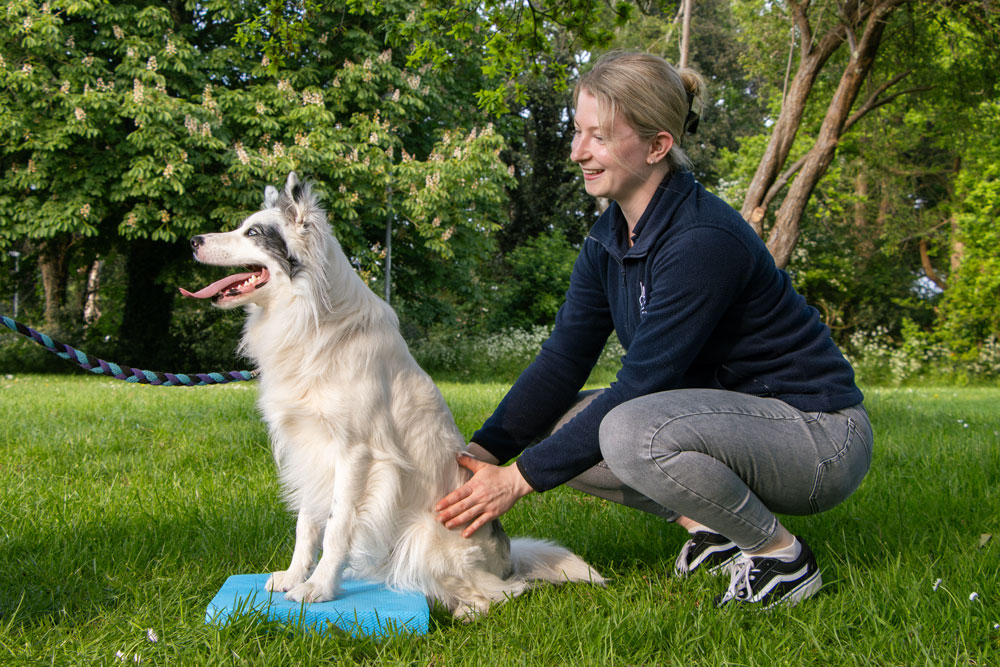
This exercise utilizes that perfect standing posture which we have encouraged and progresses it to strengthen the smallest of postural muscles. Once your dog is in their standing posture, use your hands over their thighs to gentle sway them between your hands; this should be slow and gentle, your dog should not be pushed or made unbalanced! This can also be done with the hands over the shoulder blades for strengthening of the forelimb postural muscles.
To further enhance these exercises and precisely target your dog’s specific needs, consider incorporating unstable surfaces. Tools like foam balance pads and wobble cushions can significantly increase the challenge and effectiveness of your dog’s workout. Additionally, performing exercises on inclines or declines can provide a unique and beneficial stimulus. For personalized guidance on implementing these advanced techniques, consulting a canine rehabilitation specialist is highly recommended. The payoff for this dedicated effort is a stronger, healthier dog with increased resistance to breed-specific conditions and injuries. All it takes is a few minutes of focused exercise each day to make a substantial difference. In my experience, dogs often genuinely enjoy these rehabilitation exercises, making it a rewarding and effective way to safeguard their future health and well-being.
References
Binversie, E.E., Momen, M., Rosa, G.J., Davis, B.W. & Muir, P., (2022). Across-breed genetic investigation of canine hip dysplasia, elbow dysplasia, and anterior cruciate ligament rupture using whole-genome sequencing. Frontiers in Genetics, 13, p.913354.
Blake, S., Melfi, V., Tabor, G. & Wills, A.P., (2023). Frequency of injuries and orthopaedic conditions sustained by flyball dogs. Comparative Exercise Physiology, 20(1), pp.89-96.
Boge, G.S., Moldal, E.R., Dimopoulou, M., Skjerve, E. & Bergström, A., (2019). Breed susceptibility for common surgically treated orthopaedic diseases in 12 dog breeds. Acta Veterinaria Scandinavica, 61(1), p.19.
Marcellin-Little, D.J., Levine, D. & Taylor, R., (2005). Rehabilitation and conditioning of sporting dogs. Veterinary Clinics: Small Animal Practice, 35(6), pp.1427-1439
Michael, H.E., McGowan, C.M. & Hyytiäinen, H.K., (2024). Posture and postural dysfunction in dogs: Implications for veterinary physiotherapy. The Veterinary Journal, 305, p.106107.
Millis, D.L. & Ciuperca, I.A., (2015). Evidence for canine rehabilitation and physical therapy. Veterinary Clinics: Small Animal Practice, 45(1), pp.1-27.