
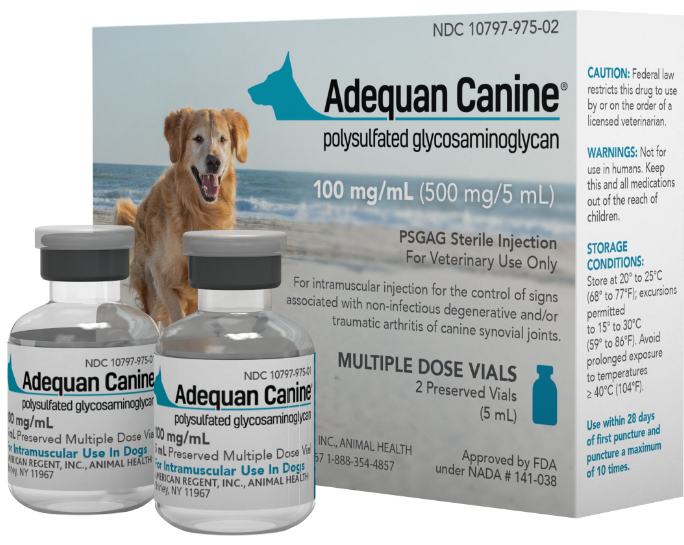
Adequan is the brand name for polysulfated glycosaminoglycan (PSGAG). Adequan is approved by the FDA for the management of OA in dogs and horses and labeled as a disease-modifying osteoarthritic drug.
Adequan protects cartilage and decreases inflammation by inhibiting the enzymes that breakdown cartilage extracellular matrix and preserving chondrocyte health. It helps increase proteins that support the cartilage and joint fluid. It does not re-build cartilage that has already been lost. Therefore, the earlier it is given in the arthritic process, the more effective it may be at slowing the progression of arthritis and decreasing pain.
Adequan is a good option for dogs that have been diagnosed with a developmental orthopedic disease (DOD) and may or may not be symptomatic (Stage 0-1). Adequan has been shown to decrease lameness, pain and inflammatory markers of OA in dogs with clinical OA (Stage 2-4).
How is it administered?
Adequan is labeled to be given intramuscularly, though we exclusively recommend giving it subcutaneously (SQ, under the skin) to avoid the pain of repeated injections into the muscle. The recommended dose is 4.4 mg/kg twice a week for 4 weeks. After this “loading dose,” many veterinarians will recommend weaning to the lowest effective dose for maintenance. For example, the second month of treatment might be once a week for 4 weeks, then every 1-4 weeks. The “loading dose” can/ should be repeated whenever an OA flare-up occurs. Clients are often given instructions on how to perform SQ injections.
The “loading dose” or label dose is based on clinical trials in dogs that established the dose with IM administration. Following IM administration, Adequan reaches synovial tissue within 2 hours and persists in the joint for at least 3 days. The pharmacokinetics are not known with SQ administration. Also, there are no clear guidelines for long-term use of Adequan beyond repeating the label dose as needed.
What does the research show?
A study by Hannan N et al (J Orthop Research, 1987) administered the human brand of Adequan (Arteparon, no longer available) to dogs following experimental meniscectomy (a model for OA development). Dogs were dosed with 2 mg/kg SQ 3x/ week for 3 weeks, then 2x/ week for 23 weeks.
No adverse effects were seen with this frequent dosing. While dogs in both the treated and control (meniscectomy without Arteparon) groups showed degeneration of articular cartilage at the end of the study, dogs that were treated with Arteparon had significantly (p<0.01) less cartilage damage, suggesting the efficacy of long term SQ dosing.
There are currently no other products that are similar to Adequan labeled for use in the US. Pentosan, brand name Cartrophen, is a disease-modifying arthritis drug that is used in Australia, Canada, and Europe. There are no studies comparing Adequan to Pentosan/Cartrophen.
References
Hannan N, Ghosh P, Bellenger C, Taylor T. Systemic administration of glycosaminoglycan polysulphate (arteparon) provides partial protection of articular cartilage from damage produced by meniscectomy in the canine. J Orthop Res 1987; 5:47-49.
Lust G, Williams AJ, Burton-Wurster N, et al. Effects of intramuscular administration of glycosaminoglycan polysulfates on signs of incipient hip dysplasia in growing pups. Am J Vet Res 1992; 53:1836-1843.
DeHaan JJ, Goring RL, Beale BS: Evaluation of polysulfated glycosaminoglycans for the treatment of hip dysplasia in dogs. Vet Surg 1994;23:177–181
Sevalla K, Todhunter RJ, Vernier-Singer M, Budsberg SC: Effect of Polysulfated Glycosaminoglycan on DNA Content and Proteoglycan Metabolism in Normal and Osteoarthritic Canine Articular Cartilage Explants. Vet Surg 2000;29: 407-414
Fujiki M, Shineha J, Yamanokuchi K, et al: Effects of treatment with polysulfated glycosaminoglycan on serum cartilage oligomeric matrix protein and C-reactive protein `concentrations, serum matrix metalloproteinases 2 and 9 activities, and lameness in dogs with arthritis. Am J Vet Res 2007;68:827–833
*The views and opinions expressed on this website are my professional views and opinions, based on my experience, and have not been reviewed by and may not represent those of American Regent Animal Health.