
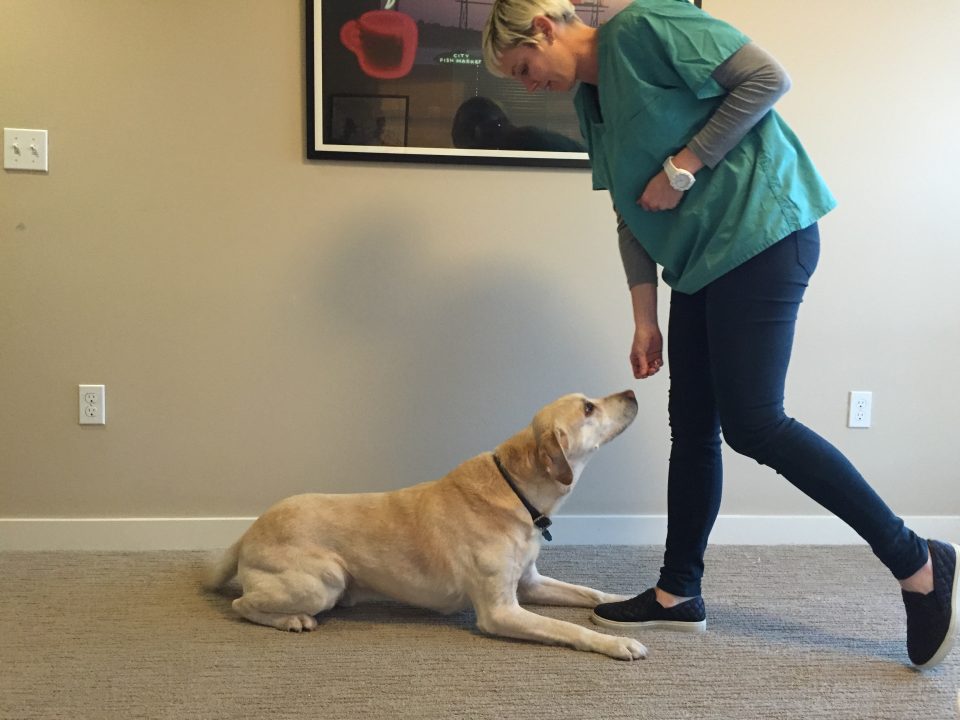
A home exercise program should always be part of your dog’s rehabilitation or conditioning plan. There are several basic principles that you will need to follow throughout the rehabilitation period as well as when performing exercises for general fitness.
Building Blocks
Therapeutic exercises are built on the foundation of basic obedience commands and “tricks.”
Here are the ones your dog should know in order to perform and progress exercises:
- Sit
- Down
- Stand
- Stay/ Wait
- Here/ Touch (not the same as “come”)
- Shake (with both paws)
- Heel (walking on a leash without pulling)
If your dog does not already know these commands, we recommend that you teach them, working with a professional dog trainer if needed. **Never use force when training. Dogs must be engaged in the activity because they want to. This will require using a reward to train with such as food, praise or a toy.
We recommend training using a clicker or capture word, such as “YES!” so that your dog can be rewarded instantly when they perform the movement or command asked of them. We also recommend “capturing” the following postures when your dog performs them naturally at home. Once they learn that these motions are “good,” they will become exercises that can be done on command.
“Capture” positions/ commands:
- Play bow (downward dog; back legs straight with rear end in the air while stretching front legs long in front of them—the CARE logo!)
- Upward dog (stretching back legs straight behind while standing straight on front legs)
- Backward walking/ backing up
Start Slow and Easy
All exercises should start very easy in order to ensure correct form (Principle 2) and to not over-stress the body. This will mean that when you start an exercise program, it may seem boring or easy. But resist the urge to push harder or overdo it. If you do too much, especially when starting an exercise program, you risk injuring your dog or at least making them very sore.
When starting a walking program, the length of the walk should be that which you are sure that your dog won’t be sore/ limping at the end. You want to establish the baseline of exercise which they can do without being sore (Principle 4). Then, you will gradually build from there (Principle 5). This may mean that the first walk is very short. That’s OK! Walking for 1-2 minutes and seeing that your dog is not more sore or limping more is much, much better than going out for 10 minutes and your dog limping home. This will set you back several days in your program before you can start to establish the baseline again.
Correct Form Matters
Practice makes perfect. It is not by luck that professional golfers can sink a put or basketball players can score 3 point shots. These athletes repeat the same swing or shot for thousands of hours, working on their correct form, so that the motions become natural and they do not have to think about their body position when in the game.
This is the magic of neuro-muscular education. Muscles get trained to do a certain task or maintain a certain posture, and then the task becomes second nature. People with poor posture do not think to themselves, “I want to slump my shoulders and hold my neck in a forward position.” (did you just sit up straighter?) Having poor posture leads to further poor posture out of neuromuscular adaptation. In other words, it becomes a habit. And then the tissues adapt to the habit in either a good or bad way. This matters for your dog too!
Reward good form
When doing therapeutic exercises, we ONLY want to do exercises with good form. Doing exercises with poor or wrong form will only reinforce the incorrect movements. This is why we start slow and easy with exercises that your dog can do correctly, then progress (Principle 5) once they have mastered an exercise with correct form.
This holds true for walking programs after surgery—we only want your dog to go for a walk if they are using their leg rather than hopping on 3 legs. Otherwise, they learn that they can get where they want to go on 3 legs, and this starts a vicious cycle of muscle loss, joint and muscle stiffness, pain, and further limiting use of the leg.
When performing repetitions of an exercise, the last repetition should be with correct form. This is why it is important to watch for signs of fatigue (Principle 4) and stop the exercise before the form is in incorrect. If you don’t catch it in time and your dog starts getting a sloppy form, give them a break for 1-2 minutes, then ask them to perform only 1 repetition of the exercise and hopefully it should be with good form.
Give lots of praise/ reward when the form is correct. Do not reward when the form is incorrect.
Be sure you know what good form looks like! Your rehabilitation therapist should provide guidance on what good and bad form is for each exercise prescribed.
Watch for Fatigue—during and after exercise
If your dog could talk to you (with words), you would ask them to tell you when they are starting to feel tired or weak during exercise. Since they can’t give you verbal feedback, you must observe closely for signs of fatigue so that you can stop the exercise before poor form develops (Principle 3).
Signs of fatigue include:
- Panting
- Lagging behind on a walk
- Limping
- Scuffing their toe nails
- Muscle tremors
- Decreased interest in the reward
- Refusal to do the exercise
- Sitting down
- Laying down
- Incorrect form
Breaks are ok
Sometimes your dog will just need a rest break, then they can do another set of exercise repetitions or walk a little bit further. Allow your dog to rest for 1-3 minutes, then ask them to do the exercise again, and if there is proper form, you can ask for a few more repetitions. Other times, especially when starting an exercise program, only one set of exercises (or a short walk) should be performed and your dog should be allowed to rest.
It is a good idea to track how many repetitions you are doing with each exercise, or how long you are walking so that you can track when fatigue develops. We have created an exercise log that can help you track this!
Furthermore, it will take about 2 weeks to start seeing improvement in fitness, then additional gains are expected to be seen approximately every 4 weeks. Since exercise does not provide instant results in strength and endurance gains, using a log where you can look back and see how far your dog has come can help you stay motivated and compliant.
Progression Matters
The body adapts to the forces placed upon it (so long as the forces are not too high that they cause injury). We use this principle to increase strength, endurance, and flexibility. But, in order to make gains in fitness, the amount of force (or load) needs to be gradually increased. If you want to run a marathon (26.2 miles), you have to train by gradually increasing the distance that you run so that your muscles, tendons, bones, heart, and lungs can adapt.
Therapeutic exercises are progressed by increasing one of the following variables:
- Time: This refers to how long you walk or how long a position, such as stretching, is held.
- Distance: How far you walk
- Intensity: This means making the exercise harder. This can be done by making the surface uneven, walking faster, adding inclines/declines, adding resistance
- Repetitions: The number of times the exercise is repeated in one “set.” A set includes a certain number of repetitions, or “reps.” Sets are separated by a break. For example, 2 sets of 5 reps would mean that your dog does 5 repetitions, takes a break (usually 1-3 minutes), then does another set of 5 reps.
- Frequency: How often the exercise is done in a day or week
Dogs get DOMS too
The feeling of sore muscles after you work out is not unique to humans. Delayed onset muscle soreness, or DOMS, can develop in dogs after they exercise, particularly if they are progressing through a rehabilitation program. DOMS typically sets in 1-2 days after exercise, then resolves by 3 days after exercise.
Why does DOMS occur?
When muscles are exercised, microscopic tears develop (this is a good thing, as opposed to a true muscle injury or strain). Once the muscle is resting, the body repairs these tiny injuries, and it is actually this process of repair that results in the muscle getting stronger. Muscles get stronger in order to adapt to the forces placed on them. Once a muscle has adapted to the new threshold, soreness is unlikely to occur. But in order to get even stronger, more force or load needs to be applied, and the process continues. DOMS is the soreness associated with the repair process in muscle adaptation to strength training.
Watch for increased soreness or limping
In the early stages of rehabilitation, we do not want dogs to get DOMS, this is why exercise should start slow and easy.
If your dog seems sore or has an increased limp 1-2 days after exercise, it is likely DOMS. The worst things to do during this period are complete rest or heavier exercise. The best thing to do is an easy, gentle walk. For example, if you have just progressed your dog to walking hills and added a new exercise and they seem sore the next day, go for a short, flat walk and skip any exercises for the next 2 days, or until the limp or soreness has resolved.
**If your dog develops a lameness that includes swelling, bruising, pain to the touch, is not using their leg at all, or continues to limp beyond the DOMS period, call your veterinarian as these could be signs of something more serious than DOMS and additional treatment may be needed.
Rest days are OK
Your therapist will give you guidance on how frequently you should be performing your home exercise plan and walks. In some instances, daily walks and exercises are good/ ideal. Other times, especially when working on fitness and conditioning for sport, rest days are essential to allow the body to recover from training.