
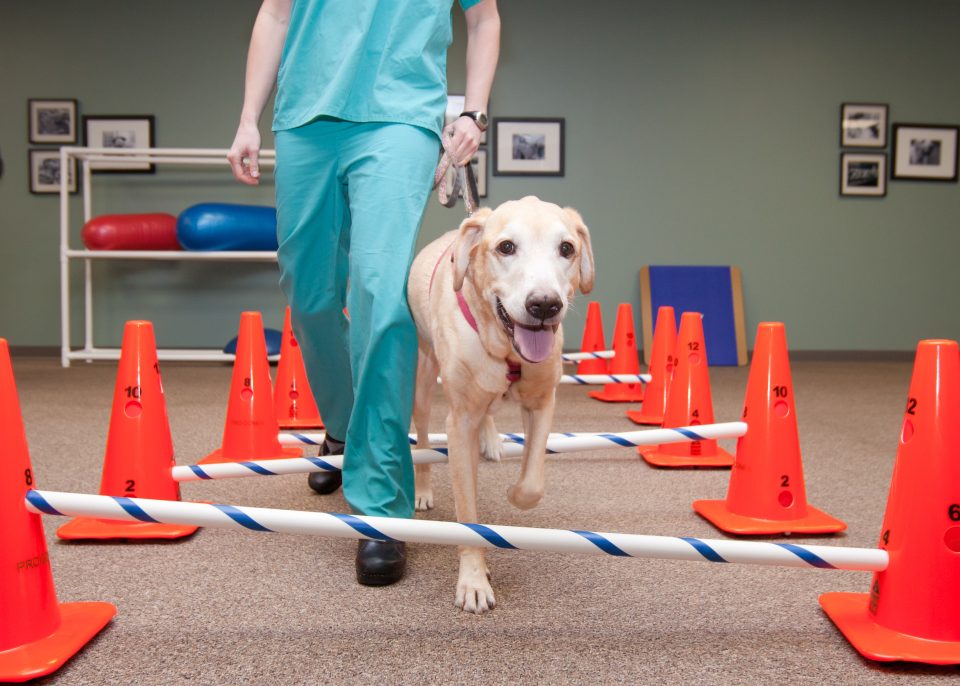
Physical rehabilitation offers a number of techniques that can be very helpful for decreasing pain and improving mobility in dogs with OA. Traditional physical rehabilitation skills can broadly be divided into three categories: manual therapy, therapeutic exercise, and therapeutic modalities.
Manual Therapy
Manual therapy is very commonly performed by human physical therapists to relieve pain and improve joint motion. Veterinary rehabilitation therapists can also use joint mobilization, soft tissue mobilization/ massage, passive range of motion (PROM), and stretching to treat dogs with OA.
Animals with OA often develop compensatory dysfunctions in surrounding soft tissues and distant joints. Rehabilitation therapists (veterinarians or physical therapists trained in canine rehab) should assess the entire animal to identify areas of compensatory pain, trigger points, or reduced mobility.
Manual therapy techniques should be applied to the arthritic joints as well as other areas of the body, as clinically appropriate. Once a veterinarian or physical therapist is trained in these techniques for dogs, the addition of manual therapy to multi-modal pain management can be very cost effective and pose a low risk for adverse effects. Veterinary technicians trained in canine rehabilitation can provide some forms of manual therapy, such as PROM, stretching, and massage.
Therapeutic Modalities
A therapeutic modality is a device or application that delivers a physical agent to the body for therapeutic purposes. Pain relief is a common indication for therapeutic modalities. Modalities frequently used in veterinary rehabilitation to treat OA include
- Cryotherapy
- Thermotherapy
- Laser
- Pulsed electromagnetic field (PEMF)
- Neuromuscular electrical stimulation/ transcutaneous electrical nerve stimulation (TENS)
- Extracorporeal shockwave therapy (ESWT).
Ice packs/ cryotherapy:
Ice is recommended to decrease inflammation following an acute injury or “flare up.” The application of ice decreases blood flow to the area and decreases the transmission of pain from the site of injury to the brain (numbs the joint).
Animals with OA can benefit from the application of an ice pack to the affected joint after exercise. The ice pack should ideally be held in place for 15-20 minutes. The ice pack should never be placed in direct contact with the skin but should be wrapped in a damp towel or pillowcase. Wrapping the ice pack with an Ace bandage to provide moderate compression will also help.
Pets should never be left unattended with the ice pack. There are several studies documenting the effects of cold compression in dogs following surgery. While cold compression or ice packs have not been specifically studied for dogs with OA, they are a practical and cost-effective means of reducing inflammation and pain which can be performed at home by the pet owner. Here is a link to a form about ice packing you can provide to your clients.
Heat packs:
Heat is recommended to reduce muscle spasms and provide a soothing sensation. The application of heat increases blood flow to an area, though the depth of penetration may not go deeper than about 1 cm. Animals with arthritis can benefit from the application of a warm pack to the low back or muscles surrounding the affected joint. NOTE: **Heat should be applied at least 2 hours after exercise and should not be used in the acute stage of injury.
Therapeutic LASER/ photobiomodulation:
Laser therapy is the application of light energy (photons) to stimulate tissue. Therapeutic lasers stimulate cellular metabolism, fibroblast proliferation, collagen deposition and enhance angiogenesis, but are not capable of cutting tissue.
Additionally, they can provide pain relief through increased secretion of serotonin, increased release of endogenous opiates, decreased inflammation and blockage of afferent C fiber depolarization. Several lasers are currently marketed for veterinary use and differ based on their wavelength and power, which influence the depth of penetration and time required for treatment, respectively, and their ability to cause injury to the eye and skin.
Dogs with OA may benefit from laser therapy to the affected joint and surrounding muscles/ trigger points. One study found that laser therapy resulted in a reduced need for NSAIDs in dogs with elbow OA.
PEMF:
All cells and tissues in the body have their own electromagnetic field. When cells are diseased or damaged, the electrical gradient across the cell membrane is disrupted, thus altering the electromagnetic field in the body.
Application of the PEMF generators has been shown to increase certain molecules (such as Nitric Oxide) that help restore the normal electromagnetic field in the body. PEMF therapy is used to decrease pain and inflammation and stimulate tissue healing.
There are studies in human and veterinary patients documenting these effects, though the optimal protocol for use for dogs with OA is not yet known. PEMF is applied through a bed that animals lay on or through disposable devices that are placed or held over the treatment area. Both of these types of devices can be purchased by clients for use at home, offering a practical, non-pharmaceutical option for pain relief with minimal to no recognized side effects.
TENS:
This modality applies a continuous, low-level electrical current to the body which stimulates a type of nerve ending that transmits sensations to the spinal cord faster than the dull ache associated with chronic pain. Therefore, the spinal cord and brain recognize the “tingly” sensation of TENS rather than pain associated with OA. Effective use of TENS may require shaving the dog’s hair if it is long, and pain relief is limited to the time that the TENS unit is actually in use. There are no studies of TENS use for dogs with OA.
ESWT:
This modality is high-powered, focused ultrasound. Sound waves are transmitted to the tissue, which stimulates cells to express growth factors and other molecules that improve healing and decrease pain. It was demonstrated by one study that dogs with unilateral hip OA treated with ESWT developed a more symmetrical gait, with peak vertical force and vertical impulse equalizing between limbs.
Another study found that ESWT for elbow OA resulted in improved peak vertical force (PVF, measured on force plate) similar to what is expected with NSAIDs. Of all of the modalities used in veterinary rehabilitation, ESWT currently has the most research in clinical veterinary patients. However, depending on the device used, ESWT may require sedation in order to avoid discomfort during application.
Therapeutic Exercise
In addition to regular aerobic exercises such as walking or swimming, therapeutic exercises should be incorporated into an OA treatment plan with goals of increasing/ maintaining strength, flexibility and proprioception such that functional mobility is maintained. Therapeutic exercises are typically taught to dogs and clients in a rehabilitation gym and then prescribed as part of a home exercise program.
Hydrotherapy
Water offers several beneficial properties that make hydrotherapy and the underwater treadmill (UWTM) very useful modalities in veterinary rehabilitation. Depending on the height of the water, the buoyancy of the water will provide varying levels of support for animals that are either weak or painful.
The cohesion and turbulence of the water provide a resistant force when walking through the water. This property is beneficial for increasing the range of motion of joints. Additionally, it is more challenging to walk through water, leading to increased muscle strength and endurance following regular therapy in an underwater treadmill.
Finally, the water temperature in most underwater treadmills or pools is kept around 85 degrees F, which helps increase blood flow to the limbs and provides a soothing environment. Studies have found that dogs enrolled in a UWTM-based rehabilitation program have improved weight loss and maintenance of muscle mass—both of which are crucially important for managing OA.
Want to learn more about Canine Rehabilitation or find a rehab professional near you? Here are some helpful links:
www.caninerehabilitationinstitute.com
References
Millis DL, Levine D, Taylor RA, eds: Canine rehabilitation and physical therapy. St. Louis, MO. Saunders; 2004.
Zink MC and Van Dyke JB, eds: Canine Sports Medicine and Rehabilitation. Ames, IA. Wiley-Blackwell; 2018
Millis DL, Levine D. The role of exercise and physical modalities in the treatment of osteoarthritis. Vet Clin North Am Small Anim Pract 27(4):913-930, 1997.
Knight KL, Draper DO: Therapeutic modalities: the art and science. Philadelphia, PA. Wolter Kluwer/Lippincott Williams and Wilkins; 2008.
Prentice WE: Therapeutic modalities: for sports medicine and athletic training. New York, NY. McGraw-Hill Higher Education; 2009.
Millis DL, Francis D, Adamson C: Emerging modalities in veterinary rehabilitation. Vet Clin Small Anim 35:1335-1355, 2005.
Barlas D, Homan CS, Thode HC: In vivo tissue temperature comparison of cryotherapy with and without external compression. Ann Emerg Med 28:436-439, 1996.
Bocobo C, Fast A, Kingery W, Kaplan M: The effect of ice on intra-articular temperature in the knee of the dog. Am J Phys Med Rehabil 70(4):181-185, 1991.
Deal DN, Tipton J, Rosencrance E, Curl WW, Smith TL: Ice reduces edema: A study of microvascular permeability in rats J Bone Joint Surg 84(9):1573-1578, 2002.
Rexing J, Dunning D, Siegel AM, Knap K, Werbe B: Effects of cold compression, bandaging, and microcurrent electrical therapy after cranial cruciate ligament repair in dogs. Vet Surg 39:54-58, 2010.
Drygas KA, McClure S, Goring RL, Pozzi A, Roberston SA, Wang C: Prospective evaluation of cold compression therapy on postoperative pain, swelling, range of motion and lameness following tibial plateau leveling osteotomy in dogs. J Am Vet Med Assoc 238(10):1284-1291, 2011.
Kieves, NR, Bergh MS, Zellner E, Wang C. Pilot study measuring the effects of bandaging and cold compression therapy following tibial plateau levelling osteotomy. J Small Anim Pract. 2016: 57(10): 543-547.
Rogatko CP, Baltzer WI, Tennant R. Preoperative low level laser therapy in dogs undergoing tibial plateau levelling osteotomy: A blinded, prospective, randomized clinical trial. VCOT 2017:30:46-53.
Tunér J, Hode L, Nobel A: The Laser Therapy Handbook. Grangesberg, Sweden. Prima Books AB; 2007.
Wong-Riley MT, Liang HL, Eells JT, et al: Photobiomodulation directly benefits primary neurons functionally inactivated by toxins: role of cytochrome c oxidase. J Biol Chem 2005;280: 4761-4771
Joensen J, Demmink JH, Johnson MI, et al: The thermal effects of therapeutic lasers with 810 and 904 nm wavelengths on human skin. Photomed Laser Surg 2011:29(3):145-153
Hashmi JT, Huang YY, Sharma SK, et al: Effect of pulsing in low-level light therapy. Lasers Surg Med 2010;42:450-466
Ilic S, Leichliter S, Streeter J, et al: Effects of power densities, continuous and pulse frequencies, and number of sessions of low-level laser therapy on intact rat brain. Photomed Laser Surg 2006;24(4):458-466
Bjordal JM, Couppe C, Ljunggren AE: Low level laser therapy for tendinopathy evidence of a dose-response pattern. Phys Therapy Rev 2001;6:91-99
Sakurai Y, Yamaguchi M, Abiko Y: Inhibitory effect of low-level laser irradiation on LPS-stimulated prostaglandin E2 production and cyclooxygenase-2 in human gingival fibroblasts. Eur J Oral Sci 2000;108: 29-34
Aimbiro F, Albertini R, Pacheco MT, et al: Low level laser therapy induces dose-dependent reductions of TNF-alpha levels in acute inflammation. Photomed Laser Surg 2006;24:33-37
Viegas VN, Abreu ME, Viezzer C, et al: Effect of low-level laser therapy on inflammatory reactions during wound healing: comparison with meloxicam. Photomed Laser Surg 2007;25: 467-473
Fulop AM, Dhimmer S, Deluca JR, et al: A meta-analysis of the efficacy of laser phototherapy on pain relief. Clin J Pain 2010;26:729-736
Bjordal JM, Couppe C, Chow RT, et al: A systematic review of low level laser therapy with location-specific doses for pain from chronic joint disorders. Aust J Physiotherapy 2003;49:107-116
Hegedus B, Viharos L, Gervain M, Galfi M: The effects of low-level laser in knee osteoarthritis: A double blind, randomized, placebo-controlled trial. Photomed Laser Surg 2009;27(4):577-584
Soriano F, Campana V, Moya M, et al: Photobiomodulation of pain and inflammation in microcrystalline arthropathies: experimental and clinical results. Photomed Laser Surg 2006;24(2):140-150
Looney AL, Huntingford JL, Blaeser LL, Mann S. A randomized blind placebo-controlled trial investigating the effects of photobiomodulation therapy on canine elbow osteoarthritis. Can Vet J 2018 59(9):959-966.
Scardino MS, Swaim SF, Sartin EA, et al. Evaluation of treatment with a pulsed electromagnetic field on wound healing, clinicopathologic variables, and central nervous system activity of dogs. Am J Vet Res. 59(9):1177-1181, 1998.
Alvarez LX, McCue J, Lam NK, et al. Effect of targeted pulsed electromagnetic field therapy on canine postoperative hemilaminectomy: A double-blind, randomized, placebo-controlled clinical trial. J Am Anim Hosp Assoc 2019; 55:83-91.
Johnson JM, Johnson AL, Pijanowski GJ: Rehabilitation of dogs with surgically treated cranial cruciate ligament deficient stifles by use of electrical stimulation of muscles. Am J Vet Res 58:1473-1478, 1997.
Sems A, Dimef R, Iannotti JP: Extracorporeal shock wave therapy in the treatment of chronic tendinopathies. J Am Acad Orthop Surg 14:195-204, 2006.
Laverty PH, McClure SR: Initial experience with extracorporeal shock wave therapy in six dogs—part 1. Vet Comp Orthop Traumatol 15: 177-183, 2002.
Dahlberg J, Fitch G, Evans RB, McClure SR, Conzemius M. The evaluation of extracorporeal shockwave therapy in naturally occurring osteoarthritis of the stifle joint in dogs. Vet Comp Orthop Traumatol 18(3): 147-52, 2005.
Mueller M, Bockstahler B, Skalicky M, Mlacnik E, Lorinson D: Effects of radial shockwave therapy on the limb function of dogs with hip osteoarthritis. Vet Rec 160(22): 762-5, 2007.
Gallagher A, Cross AR, Sepulveda G. The effect of shockwave therapy on patellar ligament desmitis after tibial plateau leveling osteotomy. Vet Surg 41(4):482-485, 2012.
Kieves NR, MacKay CS, Adducci K, et al. High energy focused shock wave therapy accelerates bone healing: A blinded, prospective, randomized canine clinical trial. VCOT. 2015:28:425-432.
Souza AN, Ferreira MP, Hagen SC, Patrício GC, Matera JM. Radial shock wave therapy in dogs with hip osteoarthritis. Vet Comp Orthop Traumatol. 2016;29(2):108-14. doi: 10.3415/VCOT-15-01-0017. Epub 2016 Jan 20.
Mueller M, Bockstahler B, Skalicky M, Mlacnik E, Lorinson D. Effects of radial shockwave therapy on the limb function of dogs with hip osteoarthritis.
Vet Rec. 2007 Jun 2;160(22):762-5.
Carr JG, Millis DL, Weng HY. Exercises in canine physical rehabilitation: range of motion of the forelimb during stair and ramp ascent. J Small Anim Pract 54(8):409-413, 2013.
Millard RP, Headrick JF, Millis DL. Kinematic analysis of the pelvic limbs of healthy dogs during stair and decline slope walking. J Small Anim Pract 51(8):419-422, 2010.
Bockstahler BA, Prickler B, Lewy E, et al. Hind limb kinematics during therapeutic exercises in dogs with osteoarthritis of the hip joints. 73(9):1371-1376, 2012.
Holler PJ, Brazda V, Dal-Bianco B, et al. Kinematic motion analysis of the joints of the forelimbs and hind limbs of dogs during walking exercise regimens. Am J Vet Res 71(7):734-740, 2010.
Marsolais GS, McLean S, Derrick T, Conzemius MG. Kinematic analysis of the hind limb during swimming and walking in healthy dogs and dogs with surgically corrected cranial cruciate ligament rupture. J Am Vet Med Assoc 222(6):739-743, 2003.
Durant AM, Millis DL, Headrick JF. Kinematics of stair ascent in healthy dogs. Vet Comp Orthop Traumatol 24(2):99-105, 2011.
Levine D, Marcellin-Little DJ, Millis DL, et al. Effects of partial immersion in water on vertical ground reaction forces and weight distribution in dogs. Am J Vet Res 71(12):1413-1416, 2010.
Piccione G, Casella S, Panzera M, et al: Effect of moderate treadmill exercise on some physiological parameters in untrained beagle dogs. Exp Anim 61(5):511-512, 2012.
Snigdha S, de Rivera C, Milgram NW, Cotman CW. Exercise enhances memory consolidation in the aging brain. Front Aging Neurosci 6(3):1-14, 2014.
Chauvet A, Laclair J, Elliott DA, German AJ. Incorporation of exercise, using an underwater treadmill, and active client education into a weight management program for obese dogs. 52(5):491-496, 2011.
Mlacnik E, Bockstahler BA, Muller M, et al. Effects of caloric restriction and moderate or intense physiotherapy program for treatment of lameness in overweight dogs with osteoarthritis. J Am Vet Med Assoc 2006; 229:1756-1760.
Marshall WG, Bockstahler BA, Hulse DA and Carmichael S. A review of osteoarthritis and obesity: current understanding of the relationship and benefit of obesity treatment and prevention in the dog. Vet Comp Orthop Trauamatol 2009;22:339-345.