
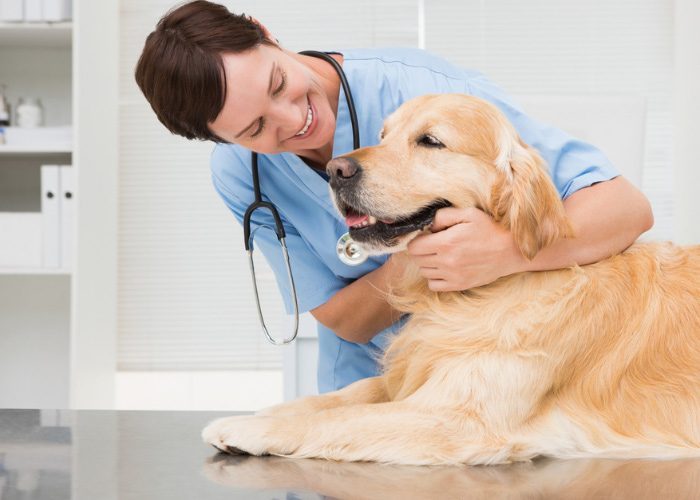
Helping clients understand how to modify activities
Historically it was thought that dogs with OA should have limited activity, and “exercise restriction” was prescribed. It turns out this recommendation is incorrect and if strictly followed, would perpetuate weight gain, joint stiffness, muscle loss and decline in functional abilities.
In humans with OA of the knees and hips, exercises including progressive resistance training, quadriceps strengthening, aquatic exercise, land-based exercise, walking, and aerobics have all been found to decrease pain and facilitate weight loss. In fact, the benefit of land-based exercise was shown to be similar to that of NSAIDs.
The American College of Rheumatology recommends aerobic exercise, muscle strengthening and preservation of joint mobility as central components of nonpharmacologic management of OA. These recommendations hold true for canine patients with OA.
What does exercise modification look like?
The best recommendation we can give for dogs with OA is “exercise modification.” This means dogs SHOULD exercise, in fact, they should ideally do something every single day rather than be weekend warriors.
The ideal exercise program for dogs with OA is regular, low impact and controlled.
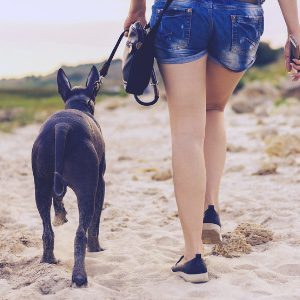 Regular exercise means that they are going for walks most days, rather than one big activity at the end of the week.
A study by Greene LM, et al in 20213 found that dogs with hip OA that exercised for >60 minutes/ day had lower lameness scores than dogs that exercised <20 minutes/day. Interestingly, in this same study, the administration of NSAIDs or chondroprotective agents was not associated with improved lameness scores. This supports the recommendation of an active lifestyle for dogs with hip dysplasia and OA. Similar studies have not yet been published for other forms of canine OA.
The type of exercise the dog is participating is important. This is where “low-impact” and “controlled” come in. To best describe this recommendation, we turn to physics (sorry, but it is easy physics).
A simple formula for how to reduce impact
Reduce Mass
A simple formula from physics states that Force = Mass x Acceleration. We want to reduce the Force on dogs’ arthritic joints, so we do that by decreasing Mass and Acceleration.
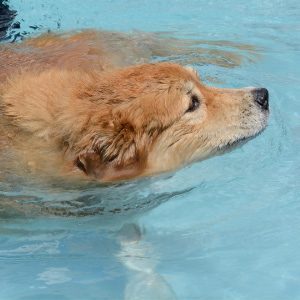
Decreasing Mass, or body weight, means losing weight or maintaining a lean body condition. Another way to effectively decrease mass during exercise is by using water. The buoyancy of water decreases the amount of weight placed on the joints.
For example, if a dog is exercising in an underwater treadmill with the water at the level of the hip, the amount of body weight borne on the joints is 38% of that which it would be on land. In other words, the amount of body weight is effectively decreased by about 60%. (Ref: Levine D, et al, 2010).
If the water level is lower, the effective reduction in body weight will be less. Swimming and underwater treadmill therapy are great, low-impact ways for dogs with OA to exercise since the amount of force on their joints will be lower, yet they will be able to gain muscular and cardiovascular strength and improve limb range of motion.
Decrease Force on Joints
The other important way to decrease Force on the joints is by decreasing Acceleration. Without getting into more physics, this is essentially how quickly force is applied to a joint.
Examples of high Acceleration (or quick force to the joint) are running and jumping (particularly jumping down). The magnitude of force to the joints is increased exponentially with high impact activities. Therefore, dogs with OA should ideally avoid running and jumping down.
Control is key
The 3rd recommendation for exercise is controlled. The best way to describe this is by saying that the dog park would be the opposite of controlled. When dogs play at the dog park, they are often running, jumping, twisting and turning quickly and placing abnormal forces on their joints. If they have abnormal joints, that is, developmental orthopedic disease or OA, these abnormal forces on their joints can be significant and often results in lameness.
So, the ideal forms of exercise for dogs with OA are those that the owner can control, including leash walking and therapeutic exercise.
However, some dogs live for the dog park, to chase balls or run in the snow. To take away their favorite form of activity may decrease their quality of life, even if it is the best medical recommendation for their OA.
Talk to clients about activity modification as part of their OA plan
Therefore, it is important to discuss ideal activities and the implications of high-impact activity with clients. The goal of comprehensive treatment of OA is that all of the other methods described to manage pain, preserve cartilage and strengthen the body are used so that dogs can enjoy the highest quality of life doing the activities they enjoy.
To summarize: the best medical recommendation for dogs with OA is that they should exercise regularly, ideally 30-60 minutes every day, and not engage in high impact activities such as running, jumping and rough play. But, the practical recommendation must be tailored to the individual dog/ client. In some instances, dogs with OA will be allowed to do activities that are not ideal for their joints, but are necessary for their overall well-being. An example of this paradox is puppies with developmental orthopedic disease, such as hip or elbow dysplasia, must still be encouraged to socialize with other dogs and people in order for them to develop appropriate social skills.
Activities not recommended for dogs with OA
CARE does not recommend the following activities for dogs with OA:
- Going for a jog/ run with the owner (Canicross)
- Flyball
- Agility
- Frisbee (Disc dog) or jumping up to catch a ball
There are numerous other canine sports that involve varying degrees of jumping, running and explosive activity. In general, these sports would put increased force on the joints of dogs and are not typically recommended, though there may be individual exceptions.
Activities that are GOOD for dogs with OA:
CARE recommends the following activities:
- Leash walks, ideally on varying terrain such as trails
- Swimming (though be careful with entry and exit from the water, especially if there are rocks or uneven terrain)
- Therapeutic exercise and underwater treadmill therapy
- Noseworks/ sent detection
- Going on outings to the store/ coffee shop, etc.
- Musical canine freestyle (dancing with your dog… YouTube it…)
References
Greene LM, Marcellin-Little DJ, Lascelles BD. Association among exercise duration, lameness severity, and hip joint range of motion in Labrador Retrievers with hip dysplasia. J Am Vet Med Assoc 20213;242:1528-1533.
Levine D, Tragauer V, Millis DL. Percentage of normal weight bearing during partial immersion at various depths in dogs. 2002; Proceedings of the 2nd International Symposium on Rehabilitation and Physical Therapy in Veterinary Medicine, Knoxville, Tenn.
Levine D, Marcellin-Little DJ, Millis DL, et al. Effects of partial immersion in water on vertical ground reaction forces and weight distribution in dogs. Am J Vet Res 2010; 71:1413-1416.