
Digging into the evidence: CARE reviews the research and how it can be incorporated into practice
Title: Effect of passive stretching on the range of motion of osteoarthritic joints in 10 Labrador retrievers.
Authors: Crook T, McGowan C, Pead M
Journal: Vet Record
Year: 2007
Background: Osteoarthritis often leads to joint stiffness and reduced range of motion (ROM). The muscles and soft tissues around the joint also lose flexibility. Consequences of reduced ROM and flexibility include pain, limping, and compensation in other joints that wind up increasing their ROM. The compensating joint often becomes hypermobile, leading to further pain and dysfunction. As such, loss of ROM in an arthritic joint creates a domino effect in the rest of the limb and body. Furthermore, the cartilage in joints receives its nutrition from joint fluid, which is moved around the joint during full ROM. And, muscles function better and are at less risk for injury when they have normal flexibility. Therefore, maintaining normal ROM and flexibility is a goal of comprehensive OA management.
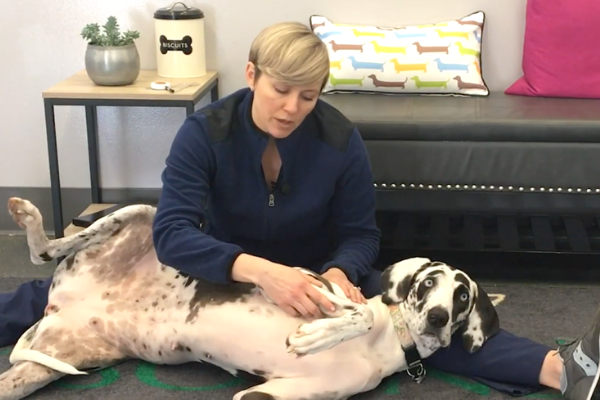
Passive range of motion is a physical rehabilitation technique in which a therapist or pet owner applies a manual force to a joint to move it through comfortable ROM. Stretching is a similar technique that accounts for both the joint motion as well as the surrounding muscles (the difference between bending and extending your elbow vs. fully bending your elbow and then stretching your triceps muscle).
The aim of this study was to determine if passive stretching of arthritic joints performed by dog owners would result in objective improvement in joint range of motion.
Study Design: Prospective clinical trial; each dog served as its own control (comparing measurements before and after intervention). The total number of dogs completing the study: 8. Dogs were included if they were Labradors over 18 months of age with radiographically confirmed OA of the elbow or stifle and there was restricted ROM of the joint. Other than starting the stretches, there could be no change in the dog’s treatment, such as medication, supplements or activity, during the 21-day study.
Intervention: Dog owners were taught to perform passive stretching of the arthritic joint, holding for 10 seconds at the end range of flexion and extension. 10 repetitions were performed twice a day for 21 days.
Outcome Measure: Goniometry of the affected joint on days 1 and 21.
Results: There was a significant (p<0.0005) increase in ROM of affected joints in all dogs after 21 days of passive stretching. The average increase in flexion angle was 14.6 degrees (range: 7-23 degrees).
Limitations: As with most veterinary studies, there was a small sample size (a small number of dogs included). The study only looked at one breed of dog, which helps with consistency, but it is not clear whether the same results could be extrapolated to other breeds (the most likely answer is yes, other breeds would show similar results). The severity of OA was not documented or consistent between dogs. The hip, shoulder, carpal and tarsal joints were not studied, so it is unclear whether similar results would be expected with performing passive stretching to these joints. Perhaps the biggest limitation, in my opinion, is the lack of clear description of stretching technique—it is not clear whether the pet owners were performing passive range of motion (moving the joint but not stretching muscles) or truly stretching the muscles around the joint (which would also include PROM); if the latter is the case, it is not clear which muscle groups are being stretched.
Conclusion/ Summary: This study provides practical, evidence-based guidance for improving ROM of the elbow and stifle joint in dogs with OA of these joints. 10 repetitions, holding the end range of flexion and extension for 10 seconds, performed twice a day for 3 weeks, can be expected to improve joint ROM. This protocol should be recommended or incorporated into management plans for dogs of OA of these (and likely other) joints.
Not sure how to do passive ROM stretching? Check out our videos here (front leg) and here (stifle).