
Guest article by Dr. Megan Ridley, DVM, and Denise Theobald, LMT, CVMRT, NCCMT
Dr. Ridley is the Medical Director at Integrative Pet Care Chicago.
Ms. Theobald is the owner/director of Canine Massage Chicago.
How does massage fit into an OA treatment plan?
Osteoarthritis (OA) is arguably the most common diagnosis in dogs. Its prevalence may be as high or higher than 20% in dogs older than one year of age and up to 80% in dogs older than 8 years of age. Unfortunately for our patients, there is no cure for OA, so treatments must be directed to alleviating symptoms.

While the administration of a variety of medications is often a necessity for controlling pain caused by OA, concerns about the side effects of long-term use of NSAIDs along with the burgeoning opioid epidemic have made both clients and veterinary professionals explore alternative medical treatments and physical modalities.
The pain pathways of OA
Understanding the mechanism, progression, and pain pathways of OA can help determine treatment modalities. OA is considered a disruption of homeostasis that involves multiple tissues within and surrounding the joint. Changes occur not just in the articular cartilage but also involve the subchondral bone, synovium, joint capsule, adjacent ligaments, and periarticular muscles. Pro-inflammatory mediators within the arthritic joint infiltrate surrounding tissues due to an increase in blood vessel permeability, propagating an inflammatory response.
These inflammatory mediators, as well as substances released from damaged cells, activate local nociceptors. Then ascending pain fibers travel from the joint to the central nervous system. As OA is a chronic disease that does not resolve, pain becomes persistent, and, as is evidenced in human studies, both peripheral and central nervous system centralization can occur, leading to maladaptive pain and hyperalgesia.
Why a multi-disciplinary approach to OA is necessary
In human patients suffering from OA, a multidisciplinary approach to management is prescribed that involves a combination of pharmacologic, nonpharmacologic, and even psychologic approaches to target central pain processing. In addition to traditional medications, exercise may be recommended to activate descending inhibitory pathways; relaxation techniques may be employed to increase the production of endogenous opioids and cannabinoids; and treatment for anxiety and depression may be used to improve the quality of life of a patient suffering from chronic pain.
The AAHA/AAFP Pain Management Guidelines for Dogs and Cats also recommend an integrated approach for the treatment of OA (called degenerative joint disease in the guidelines) in animals. Epstein et. al. recommend using rehabilitation modalities such as exercise and manual therapy techniques including joint mobilizations, massage, and myofascial release in conjunction with other pharmacological and physical medicine modalities.
What studies have found about massage
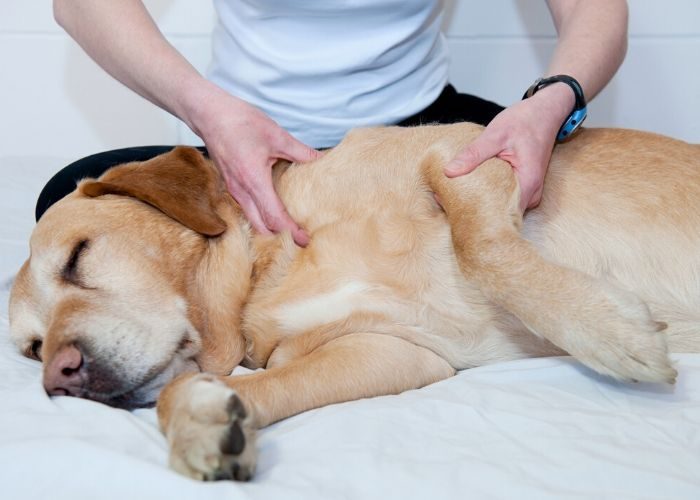
One of these therapies, massage, has recently been investigated in a compelling amount of research in human medicine for its use in chronic, painful conditions, including OA. Generally, massage elicits neurophysiological responses that decrease pain through two mechanisms of action. First, massage can suppress painful output by inhibiting dorsal root nociceptors via the gate control theory, and, second, analgesia is promoted through modulation of nociceptive circuits with oxytocin, endogenous opioids, and endocannabinoids.
Specifically, studies in humans have shown that massage therapy can increase beta-endorphins, oxytocin, and serotonin; decrease cortisol production, blood pressure, and heart rate; and activate the parasympathetic nervous system. Research explicitly focusing on massage therapy as a treatment for OA has shown that human subjects with neck OA had a reduction in pain and an increase in range of motion with massage therapy. Those with knee OA who received massage therapy showed a decrease in pain and improvement in function, range of motion, and gaiting speed.
Observations in animal patients
Similar studies in animal patients with OA are lacking thus far and should be pursued to determine if results are comparable. In the meantime, anecdotally and observationally, our patients appear to be benefitting from massage therapy. As a result, training in the field has surged as has the incorporation of massage therapy into what are considered more traditional treatments.
Techniques and approaches
Various massage therapy techniques exist, each of which can evoke a different physiologic response and may target specific ailments. The techniques listed below encompass several that are beneficial in patients with OA.
- Effleurage is a fundamental Swedish massage technique. It usually marks the beginning of a massage session and consists of long, fluid movements with a relaxed, flat hand or fingers. Effleurage is used for palpation, and it is also a warming stroke that prepares the soft tissues for more specific techniques. Effleurage is relaxing but also functions to move fluids through the body, encouraging improved circulation and lymphatic drainage.
- The Passive Hold, also known as the Laying of Hands, is another basic but important technique that can initiate a massage. Passive holding is the application of touch, without pressure, to help connect with the patients, acclimate them to touch and warm and soften superficial tissues. It is applied with a loose flat palm or fingers. This technique is used as a precursor to ischemic compression.
- Ischemic Compression can be broadly applied to a general area of the body or to a more specific, localized area. This technique is particularly useful for hypersensitive, hypertonic, and contracted muscles which may be present around arthritic joints. Like the passive hold, broad ischemic compression is applied with a flat palm or fingers. A small amount of pressure is then added to engage into the tissue to spread and separate muscle fibers. Applying a pumping action while using broad ischemic compression can help clear the tissue of metabolic wastes while allowing an influx of blood, oxygen, and other nutrients. Broad ischemic compression is often used prior to more localized ischemic compression techniques to deactivate myofascial trigger points.
- Myofascial Trigger Point Therapy is a more advanced massage technique that the trained practitioner uses to deactivate active or latent myofascial trigger points that may be causing pain and limiting the joint range of motion. A trigger point (also known as a myofascial trigger point or MTrP) is defined by Travell and Simons as “a hyperirritable localized spot in skeletal muscle that is associated with a hypersensitive palpable nodule in a taut band.” MTrPs, which have been viewed by electron microscopy, occur when overstimulated sarcomeres become unable to release their contracted state. The resulting shortening of surrounding muscles and fascia places pressure on nearby nerves, blood vessels and lymphatic channels. This creates a local buildup of fluid and inflammatory waste that can cause pain and limit joint range of motion. In humans, there is evidence that myofascial pain and the presence of MTrPs may play a role in the pain and disability of knee OA and that using a treatment that focuses on MTrPs can be effective in reducing pain and improving function in OA patients. This relationship needs to be studied and quantified in animals but similar results are seen in practice.
- Locating myofascial trigger points requires assessment through passive range of motion (PROM) and direct palpation to detect the existence of taut bands of muscle fibers. The practitioner may also note the existence of small nodules or granular build up in the soft tissues. Once located, MTrPs are deactivated by applying light pressure with a thumb or finger at a 45-90 degree angle to the tissue. Pressure is held steady for about 8-12 seconds. As the MTrP releases, pressure can be gradually increased. Once the sensitivity has diminished, a stripping motion is applied along the muscle fibers with the thumb or finger.
- Transverse Friction, also known as cross-fiber friction, another advanced massage technique, was developed by British orthopedic surgeon Dr. James Cyriax in the 1940s. This technique breaks down excessive scar tissue and decreases myofascial constrictions. It can be applied across tendons, ligaments and fascial structures that surround the affected joint or compensatory joints. It can also be used to treat satellite attachment MTrPs. The thumb or finger(s) is applied at a 90-degree angle with pressure deep enough to pin down superficial tissue to underlying tissues or bone. A short, sweeping stroke is applied in one direction, transversely over the underlying fibers. The technique produces mild trauma to the tissue, thereby increasing circulation to the site. It also generates an analgesic effect. The result of transverse friction is a release of contracted tissues, leading to an increase in range of motion at the joint.
- Lymphatic Massage is used to clear edema and reduce swelling around an arthritic joint. Using a flat hand or fingers, pressure should be deep enough so that strokes do not slide over the skin, but not so deep as to press below subcutaneous levels, collapsing lymphatic channels. Strokes should stretch the skin and move from proximal to distal and cranial to caudal towards local lymph nodes. This promotes lymphatic draining to help clear edema and trapped inflammatory byproducts, resulting in greater movement at the joint.
Summary
Canine massage techniques are an effective way to help dogs in any number of situations, from wellness and relaxation to more advanced orthopedic and post-surgical scenarios. One of the more common reasons canine massage therapists work with dogs, though, is to help manage canine arthritis. Because of the benefits massage provides, the canine massage therapist can play a vital role as a member of the dog’s health care team. The tools the therapist brings to his or her work range from basic to advanced, but all are vital for meeting the challenges that come with working effectively with canine arthritis.
References
Atkins DV, Eichler DA. The effects of self-massage on osteoarthritis of the knee: a randomized, controlled trial. Int J Ther Massage Bodywork. 2013;6(1):4-14.
Bouta EM, Bell RD, Rahimi H, Xing L, Wood RW, Bingham CO, Ritchlin CT, Schwarz EM. Targeting lymphatic function as a novel therapeutic intervention for rheumatoid arthritis. Nat Rev Rheumatol. 2018 Feb;14(2):94-106.
Dickinson BD, Head CA, Gitlow S, Osbahr AJ 3rd. Maldynia: pathophysiology and management of neuropathic and maladaptive pain–a report of the AMA Council on Science and Public Health. Pain Med. 2010 Nov;11(11):1635-53.
Diego MA, Field T. Moderate pressure massage elicits a parasympathetic nervous system response. Int J Neurosci. 2009;119(5):630-8.
Dor A, Kalichman L. A myofascial component of pain in knee osteoarthritis. J Bodyw Mov Ther. 2017 Jul;21(3):642-647.
Epstein M, Rodan I, Griffenhagen G, Kadrlik J, Petty M, Robertson S, Simpson W. 2015 AAHA/AAFP Pain Management Guidelines for Dogs and Cats. J Am Anim Hosp Assoc. 2015 Mar-Apr;51(2):67-84.
Field T, Diego M, Gonzalez G, Funk CG. Neck arthritis pain is reduced and range of motion is increased by massage therapy. Complement Ther Clin Pract. 2014 Nov;20(4):219-23.
Field T, Diego M, Hernandez-Reif M. Moderate pressure is essential for massage therapy effects. Int J Neurosci. 2010 May;120(5):381-5.
Gallagher RM. Chronification to maldynia: biopsychosocial failure of pain homeostasis. Pain Med. 2011 Jul;12(7):993-5.
Holey LA, Dixon J, Selfe J. An exploratory thermographic investigation of the effects of connective tissue massage on autonomic function. J Manipulative Physiol Ther. 2011 Sep;34(7):457-62.
https://www.acvs.org/small-animal/osteoarthritis-in-dogs
Johnston, SA. Osteoarthritis. Joint anatomy, physiology, and pathobiology. Vet Clin North Am Small Anim Pract. 1997 Jul; 27(4):699-723.
Kaada B, Torsteinbø O. Increase of plasma beta-endorphins in connective tissue massage. Gen Pharmacol. 1989;20(4):487-9.
Man GS, Mologhianu G. Osteoarthritis pathogenesis – a complex process that involves the entire joint. Journal of Medicine and Life. Vol. 7, Issue 1, Jan-Mar 2014: 37-41.
Morhenn V, Beavin LE, Zak PJ. Massage increases oxytocin and reduces adrenocorticotropin hormone in humans. Altern Ther Health Med. 2012 Nov-Dec;18(6):11-8.
Nelson NL, Churilla JR. Massage Therapy for Pain and Function in Patients With Arthritis: A Systematic Review of Randomized Controlled Trials. Am J Phys Med Rehabil. 2017 Sep;96(9):665-672.
Neogi T. The Epidemiology and Impact of Pain in Osteoarthritis. Osteoarthritis Cartilage. 2013 September; 21(9): 1145–1153.
O’Neill, TW, Felson DT. Mechanisms of Osteoarthritis (OA) Pain. Curr Osteoporos Rep. 2018 Oct;16(5):611-616. doi: 10.1007/s11914-018-0477-1.
Perlman A, Fogerite SG, Glass O, Bechard E, Ali A, Njike VY, Pieper C, Dmitrieva NO, Luciano A, Rosenberger L, Keever T, Milak C, Finkelstein EA, Mahon G, Campanile G, Cotter A, Katz DL. Efficacy and Safety of Massage for Osteoarthritis of the Knee: a Randomized Clinical Trial. J Gen Intern Med. 2019 Mar;34(3):379-386.
Perlman AI, Ali A, Njike VY, Hom D, Davidi A, Gould-Fogerite S, Milak C, Katz DL. Massage therapy for osteoarthritis of the knee: a randomized dose-finding trial. PLoS One. 2012;7(2):e30248.
Perlman AI, Sabina A, Williams AL, Njike VY, Katz DL. Massage therapy for osteoarthritis of the knee: a randomized controlled trial. Arch Intern Med. 2006 Dec 11-25;166(22):2533-8.
Simons DG, Travell JG, Simons LS. Travell & Simon’s myofascial pain and dysfunction: the trigger point manual. Vol. 1. 2nd ed. Baltimore, MD: Williams & Wilkins; 1999.
Sofat N, Ejindu V, Kiely P. What makes osteoarthritis painful? The evidence for local and central pain processing. Rheumatology (Oxford). 2011 Dec;50(12):2157-65.
Takamoto K, Sakai S, Hori E, Urakawa S, Umeno K, Ono T, Nishijo H. Compression on trigger points in the leg muscle increases parasympathetic nervous activity based on heart rate variability. J Physiol Sci. 2009 May;59(3):191-7.